
Rates verified May 2026. Chargeback fee: $15 USD equivalent per dispute in all countries. No monthly fees on standard plan. Calculate your exact fees →
Stripe fees vary significantly by country. Here are the 2026 rates
for the most searched markets:
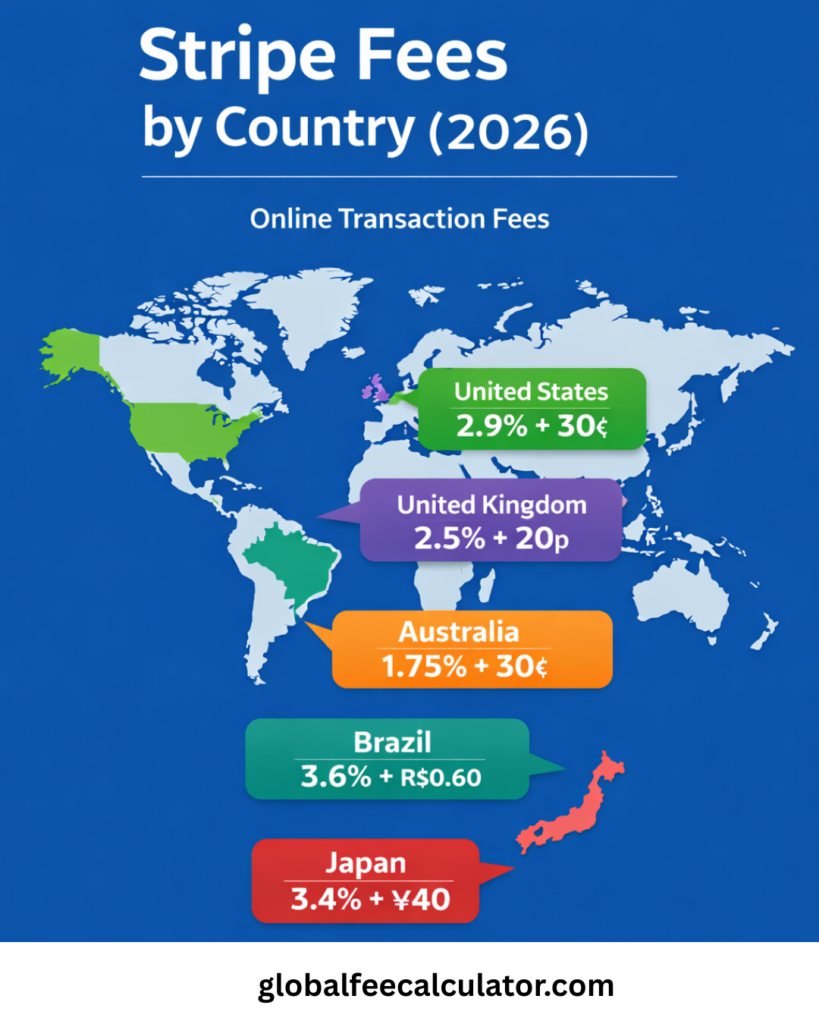
– United States: 2.9% + $0.30 per transaction
– United Kingdom: 1.5% + £0.20 per transaction
– Australia: 1.75% + A$0.30 per transaction
– Canada: 2.9% + C$0.30 per transaction
– European Union: 1.5% + €0.25 per transaction
– Germany: 1.5% + €0.25 per transaction
– France: 1.5% + €0.25 per transaction
– India: 2% domestic per transaction
– Brazil: varies by card type
– Singapore: 3.4% + S$0.50 per transaction
– Japan: 3.6% + ¥30 per transaction
– Mexico: 3.6% + MX$3.00 per transaction
All rates are for domestic card transactions. International cards
and currency conversion carry additional charges — covered in
detail below.
This guide breaks down Stripe’s exact fees for the US, UK, Australia,
Canada, Germany, and the wider EU in 2026 — including domestic rates,
international surcharges, and currency conversion costs — so you can
calculate your real cost before pricing your products or expanding
into new markets.
Table of Contents
ToggleWhy Stripe Fees Differ by Country
Stripe operates in dozens of countries, but payment processing costs are influenced by:
• Local banking infrastructure
• Card network interchange rates
• Currency conversion requirements
• Regulatory and compliance costs
• Domestic vs cross-border card usage
Although Stripe keeps its pricing transparent, each country has slightly different base rates and fixed transaction amounts. For a complete breakdown of Stripe’s pricing model, see our detailed guide on how Stripe fees work.
For a breakdown of how international and cross-border fees are calculated on top of these base rates, read our guide on Stripe international transaction fees explained.
Stripe Fees by Country (Quick Overview)
Stripe payment processing fees vary slightly depending on the country where your business operates. In most regions, Stripe charges a percentage of each transaction plus a fixed fee, but the exact pricing depends on local banking systems and regulations.
For example, Stripe typically charges 2.9% + $0.30 per online payment in the United States, 1.5% + £0.20 in the UK, and 1.75% + AU$0.30 in Australia for domestic cards.
The comparison below shows how Stripe pricing differs across major countries in 2026.
Stripe Fees by Country (2026 Comparison)
| Country | Domestic Card Fee | International Card Fee | Fixed Fee |
|---|---|---|---|
| 🇺🇸 USA | 2.9% | +1.5% | $0.30 |
| 🇬🇧 UK | 1.5% | 2.5%+ | £0.20 |
| 🇦🇺 Australia | 1.75% | 2.9% | A$0.30 |
| 🇨🇦 Canada | 2.9% | +1.5% | C$0.30 |
| 🇩🇪 Germany | 1.5% | 2.9% | €0.25 |
| 🇸🇬 Singapore | 3.4% | +1.5% | S$0.50 |
| 🇯🇵 Japan | 3.6% | +1.5% | ¥30 |
| 🇳🇿 New Zealand | 2.7% | +1.5% | NZ$0.30 |
| 🇮🇪 Ireland | 1.5% | +1.5% | €0.25 |
| 🇳🇱 Netherlands | 1.5% | +1.5% | €0.25 |
Stripe Fees in the United States (USA)
Stripe’s standard online card processing fee in the United States is typically:
2.9% + $0.30 per successful card transaction
Additional charges may include:
• +1.5% for international cards
• +1% for currency conversion
• Dispute fee (chargeback fee)
• Refund fee policies
The U.S. structure is considered the benchmark model that many other countries are compared against.
For domestic U.S. businesses selling primarily to U.S. customers, Stripe’s pricing remains predictable and competitive.
For USA sellers also using PayPal, see our PayPal US fee calculator to compare processor costs.
Stripe Fees in the United Kingdom (UK)
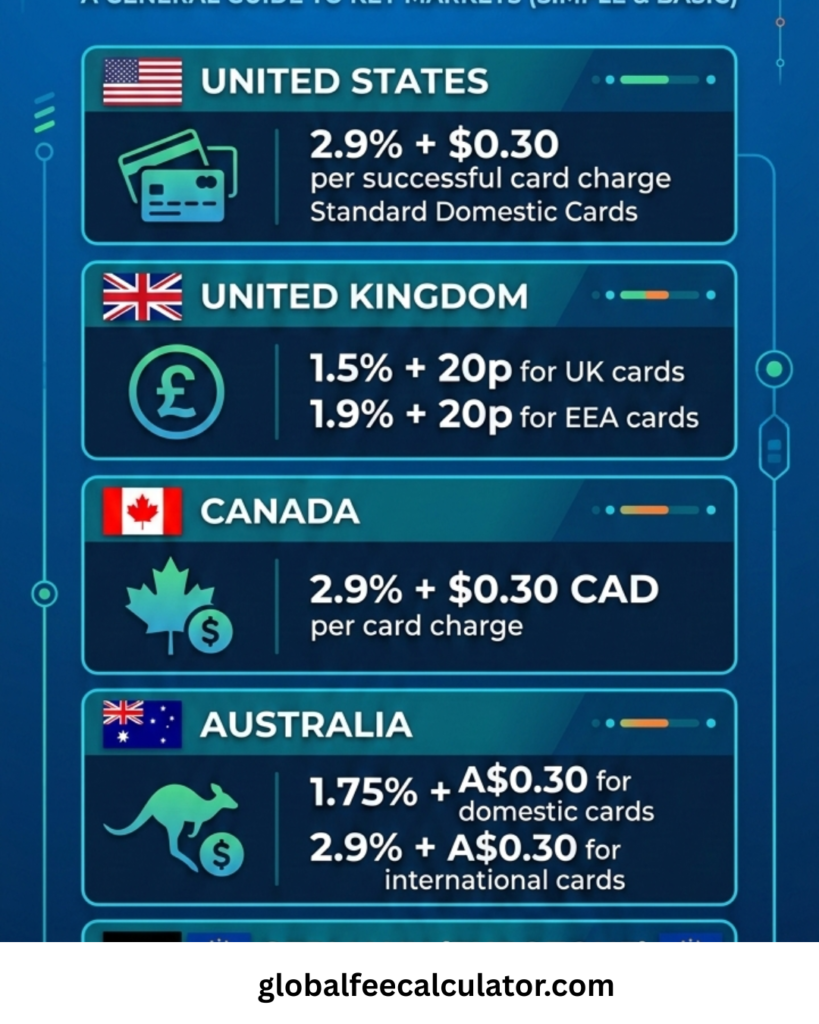
In the UK, Stripe’s standard online processing fees are generally:
1.5% + £0.20 for UK cards
2.5% + £0.20 for EU cards
International cards outside Europe may incur additional percentage charges.
Because UK card interchange rules differ from U.S. regulations, the base percentage is often lower than U.S. domestic rates. However, cross-border and currency conversion charges can increase the effective cost.
For UK sellers also using PayPal, see our PayPal UK fee calculator to compare processor costs.
Stripe Fees in Australia
For Australian businesses, Stripe typically charges:
1.75% + A$0.30 for domestic cards
2.9% + A$0.30 for international cards
Australia benefits from relatively strong domestic card pricing, but international transactions can raise total costs significantly.
Businesses selling globally from Australia should carefully account for:
• Cross-border surcharges
• FX conversion fees
• Multi-currency settlement charges
Stripe Fees in Canada
Stripe’s standard Canadian pricing usually follows this structure:
2.9% + C$0.30 for domestic cards
Additional fees apply for:
• International cards
• Currency conversion
• American Express or premium card types
Canada’s domestic processing costs are similar to U.S. pricing, but cross-border fees are more noticeable for businesses selling internationally. For Canadian businesses also using PayPal, see our PayPal Canada fee calculator to compare processor costs.
Stripe Fees in Germany
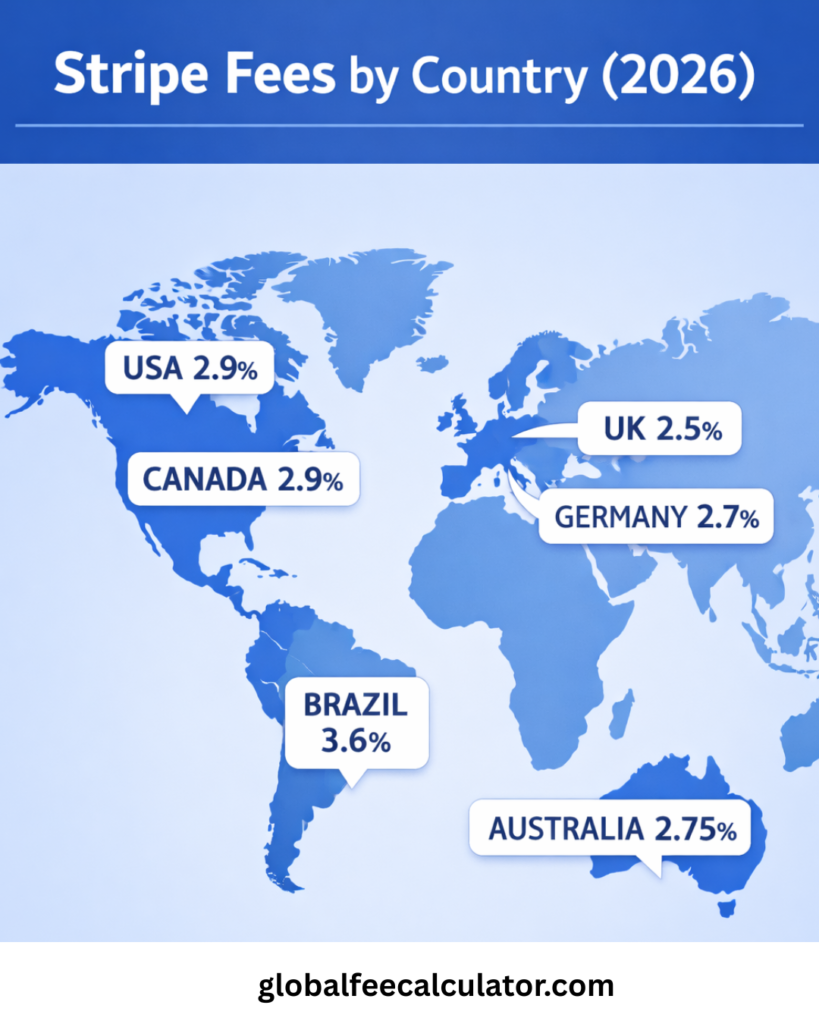
For businesses operating in Germany, Stripe typically charges:
1.4% + €0.25 for European Economic Area (EEA) cards
2.9% + €0.25 for international cards
Germany benefits from regulated interchange fees within the European Union, which makes domestic and EU card processing more affordable compared to U.S. pricing.
However, businesses accepting non-EU cards may incur:
• Cross-border surcharges
• Currency conversion fees
• Additional processing percentages
For German businesses selling globally, the international card mix significantly affects effective processing costs. For German businesses also using PayPal, see our PayPal Germany fee calculator to compare processor costs.
Stripe Fees in Europe (2026)
Businesses operating anywhere in the European Economic Area (EEA)
benefit from some of the lowest Stripe rates globally. This includes
France, Germany, the Netherlands, Italy, Spain, Ireland, and 19 other
member countries — all sharing the same fee structure.
Standard EEA domestic card fee: 1.5% + €0.25 per transaction
Premium EEA cards (corporate, commercial): 1.9% + €0.25
UK cards processed in EU accounts: 2.5% + €0.25
Non-EEA international cards: 3.25% + €0.25
Compare against PayPal’s European rates in our PayPal fee calculator.
Why are EU rates lower than those in the US?
The European Union caps interchange fees under the Interchange Fee Regulation (IFR) — limiting what card networks can charge merchants. This regulation directly reduces the base cost that Stripe passes on to businesses. US merchants pay 2.9% because no equivalent cap exists there.
For French businesses, the domestic rate is 1.5% + €0.25. For Netherlands-based sellers, the same rate applies. Currency conversion adds approximately 1% if you settle in a currency other than euros.
One important exception: Norway and Switzerland are not in the EU and
carry slightly higher domestic rates than standard EEA countries.
Always verify current rates at stripe.com before making pricing decisions.
Sellers using Stripe alongside marketplaces can also estimate Etsy seller fees in Germany.
What Happens With International Transactions?
Stripe applies additional fees when:
• The customer’s card is issued outside your country
• The transaction involves currency conversion
• Funds must be settled in a different currency
Common additions include:
• +1.5% for international cards
• +1% for currency conversion
This means a transaction advertised as “2.9% + $0.30” could effectively become 4% to 5% depending on the situation.
For global sellers, this is where profit erosion often happens.
Stripe Currency Conversion Fees
When Stripe converts funds from one currency to another, it applies a conversion margin on top of the mid-market exchange rate.
This fee typically adds around:
+1% of the transaction amount
Currency conversion fees are often not visible as a separate line item. Instead, they are built into the exchange rate used for settlement.
Businesses operating in multiple currencies should evaluate:
• Whether to use multi-currency accounts
• Whether to price in local currencies
• How conversion affects recurring billing
Real Example: $100 Sale Comparison Across Countries
To understand how Stripe fees differ in practice, let’s compare a $100 equivalent transaction processed domestically in each country.
United States
2.9% of $100 = $2.90
$0.30 fixed fee
Total = $3.20
Effective rate = 3.2%
If the card is international:
Add +1.5%
Total cost could exceed $4.70
United Kingdom (£100 equivalent)
1.5% = £1.50
£0.20 fixed fee
Total = £1.70
Effective rate = 1.7%
For EU or international cards, the percentage increases and total fees can exceed 3%.
Australia (A$100 equivalent)
1.75% = A$1.75
A$0.30
Total = A$2.05
International card:
2.9% + A$0.30
Total = A$3.20
Canada (C$100 equivalent)
2.9% = C$2.90
C$0.30
Total = C$3.20
International card transactions can raise total effective cost above 4%.
Germany (€100 equivalent)
1.4% = €1.40
€0.25
Total = €1.65
International cards:
2.9% + €0.25
Total = €3.15
Check how the strip fees change for SaaS vs. E-commerce Business
Country Calculators
Calculate Your Exact Stripe Fees by Country
Each calculator applies your country's exact domestic rate, international surcharges, and currency conversion — not US-based estimates.
How Country-Based Fees Impact Profit
Even small differences matter.
Example:
If you process $50,000 per month:
• 0.5% difference = $250 per month
• $3,000 per year
For subscription businesses and SaaS platforms, recurring billing magnifies this difference over time.
That is why businesses expanding internationally must review Stripe’s country-specific pricing before entering new markets.
How to Calculate Your Real Stripe Costs
To calculate your actual Stripe cost:
Identify your base domestic rate
Determine the percentage of international transactions
Factor in currency conversion charges
Add dispute or refund costs
Calculate effective blended rate
Using a Stripe fee calculator helps model:
• Domestic vs international revenue
• Subscription billing
• Multi-currency scenarios
• Profit impact at scale
Use our Stripe fee calculator to estimate your exact transaction cost.
Hidden Costs Businesses Often Miss
Beyond base transaction rates, businesses should also evaluate:
• Dispute and chargeback fees
• Radar fraud protection add-ons
• Subscription billing tools
• Instant payout fees
• Terminal or hardware costs
• Tax handling fees in certain regions
While these are not always part of standard transaction pricing, they affect total cost of ownership.
For SaaS and subscription platforms, even small add-on fees can accumulate significantly over time.
When Stripe Becomes More Expensive
Stripe can become costly when:
• Most customers are international
• Average order value is low
• Refund rates are high
• Currency conversion is frequent
• Cross-border transactions dominate
In those cases, effective fees may approach 4% to 5%. If you’re comparing processors, read our Stripe vs PayPal vs Square comparison.
When Stripe Is Cost-Effective
Stripe remains competitive when:
• Most customers are domestic
• Average transaction value is higher
• You negotiate custom pricing
• You use ACH or local payment methods
High-volume businesses may also qualify for volume discounts.
Stripe vs Local Alternatives by Country
In some countries, Stripe competes with strong local processors.
For example:
United States
Stripe competes with Square, PayPal, and Shopify Payments.
United Kingdom
Stripe competes with Adyen, PayPal, and Shopify Payments.
Australia
Stripe competes with Square and local bank-backed gateways.
Germany
Stripe competes with PayPal and local European payment providers.
While Stripe offers strong developer tools and global scalability, local alternatives may offer lower domestic rates in certain cases.
Businesses should evaluate:
• Domestic card mix
• International sales ratio
• Subscription needs
• Negotiation flexibility
Cost alone should not determine processor choice — integration capability and reliability matter equally.
Effective Stripe Rate: How to Calculate Your Blended Percentage
Most businesses look at Stripe’s headline rate, such as 2.9% + $0.30, and assume that is their actual cost. In reality, the effective Stripe rate is often higher.
Your blended rate depends on:
• Percentage of international customers
• Currency conversion frequency
• Average order value
• Refund and dispute volume
• Card mix (standard vs premium cards)
Step 1: Identify Total Fees Paid
Review your Stripe dashboard and calculate the total fees paid over a month.
For example:
Total processed volume: $50,000
Total Stripe fees paid: $1,850
Effective rate = 1,850 ÷ 50,000 = 3.7%
This number often surprises businesses because it includes:
• International card surcharges
• Currency conversion margins
• Dispute fees
• Fixed per-transaction fees
Step 2: Understand Fixed Fee Impact
The fixed fee portion becomes more expensive for low-value transactions.
For example:
$5 transaction in the U.S.
2.9% = $0.145
$0.30 fixed fee
Total = $0.445
Effective rate = 8.9%
Low-ticket businesses such as digital downloads or micro-SaaS products experience much higher effective percentages.
Step 3: International Expansion Scenario
Assume:
50% domestic sales
50% international sales
If international transactions add 1.5% surcharge plus 1% currency conversion, your blended rate may approach:
4% to 4.5%
At $100,000 per month in revenue:
0.5% difference = $500 monthly
$6,000 annually
For scaling startups, this margin gap compounds quickly.
Strategic Considerations Before Choosing a Processing Country
For international businesses, some founders consider incorporating in different jurisdictions.
Before doing so, evaluate:
• Tax implications
• Settlement currency
• Bank account requirements
• Chargeback laws
• Local compliance costs
Payment fees should not be the sole reason for choosing a business location, but they should be modeled carefully.
Final Thoughts: Should You Worry About Stripe Country Fees?
Stripe’s pricing is transparent, but country differences matter — especially for global sellers.
Domestic businesses may find Stripe highly predictable.
International businesses must carefully account for cross-border and currency conversion fees.
Understanding Stripe fees by country allows you to:
• Price correctly
• Protect margins
• Plan global expansion
• Compare alternative processors
The key is not avoiding fees — but calculating them accurately.
Frequently Asked Questions
Do Stripe fees differ by country?
Yes. Domestic card rates and fixed fees vary by country.
Are international Stripe transactions more expensive?
Yes. Stripe typically adds around 1.5% for international cards and 1% for currency conversion.
Does Stripe charge the same rate worldwide?
No. Each country has its own base rate and fixed transaction amount.
Are Stripe currency conversion fees separate?
They are usually embedded into the exchange rate applied during settlement.
Can businesses negotiate Stripe fees?
Yes. High-volume businesses can request custom pricing.
How do I calculate my effective Stripe rate?
Divide total Stripe fees paid by total revenue processed.
Is Stripe cheaper than PayPal internationally?
It depends on transaction type, country, and volume.
What country has the lowest Stripe fees?
Countries in the European Economic Area often have lower domestic card processing fees because of regulated interchange rates.
Does Stripe charge extra for international cards?
Yes. Stripe typically adds around 1.5% for international cards plus 1% for currency conversion.
Recommendation:
Always verify current fee structures on Stripe’s official website before making pricing or business decisions.