
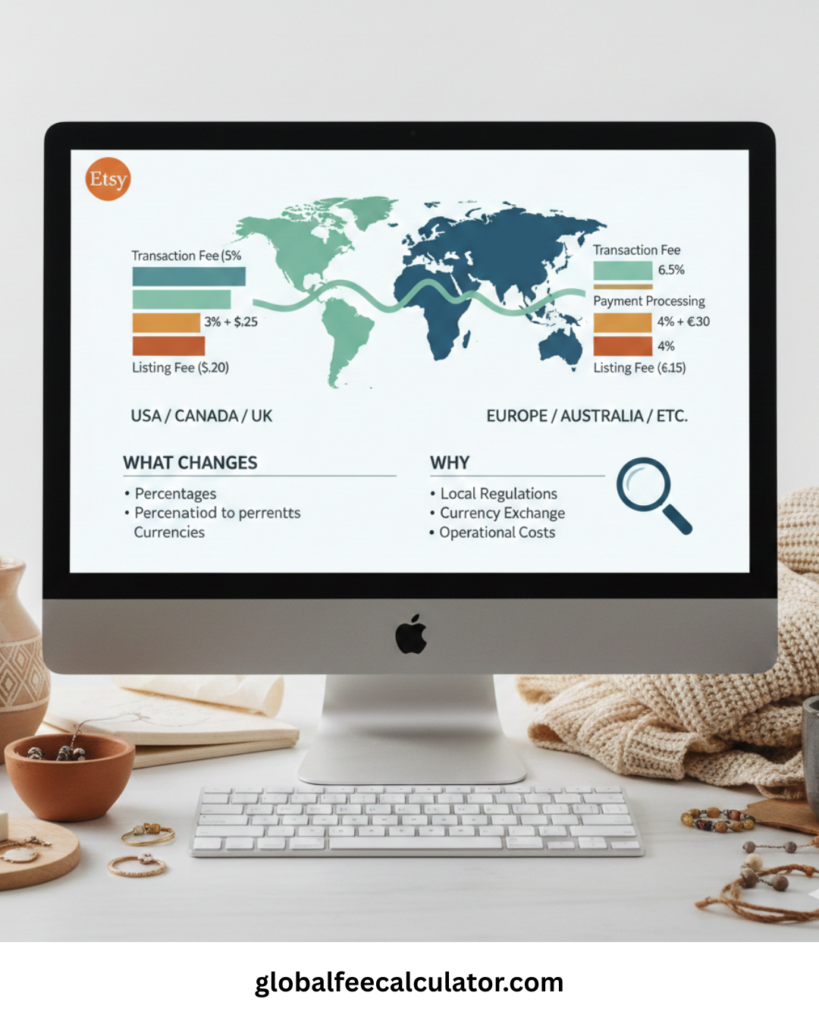
Etsy is a global marketplace connecting millions of buyers and sellers around the world. But while the idea of selling on Etsy is the same whether you’re in the USA, India, the UK, or Australia, the fees you pay can differ significantly by country. These differences affect seller profitability, pricing decisions, and even how you plan your inventory and shipping.
Understanding how Etsy fees vary by country and why helps sellers price products correctly, avoid surprises, and make smarter decisions about international sales. This guide walks through the core fee categories on Etsy, how country differences affect them, and what sellers should watch out for in 2026.
Table of Contents
ToggleWhy Etsy Fees Vary by Country
Etsy seller fees are structured to reflect:
Local tax and regulatory requirements
Currency and payment processing costs
Marketplace facilitator policies
Banking and settlement differences
While the core fee types are consistent, the amount you pay and how fees are calculated depends on where your Etsy shop is registered and where your buyers are located.
In 2026, most of these principles still apply, though individual percentages and dollar/foreign currency equivalents can change over time.
Before comparing regional differences, it’s important to understand how Etsy fees work across listings, transactions, and hidden costs.
Core Etsy Fee Categories (Same Across Countries — But Amounts Vary)
Before diving into country differences, it’s important to understand the main fees Etsy charges sellers:
Listing Fees — Charged when you publish an item
Transaction Fees — Charged on items sold
Payment Processing Fees — Charged when Etsy processes the payment
Advertising/Offsite Ads Fees — Charged when sales come from Etsy-driven ads
Currency Conversion Fees — Charged when conversions occur
Tax-Related Charges — Vary by region depending on tax laws
These fees combine to determine your net payout per sale.
Because rates and fixed fees vary, using a tool to calculate Etsy fees accurately helps sellers estimate real profit in their region.
1. Listing Fees Across Countries
What a Listing Fee Is
When you list a product on Etsy, you pay a small listing fee. This fee is charged when you publish the item, and then again if you renew it after expiration.
How Listing Fees Vary
While the concept is the same everywhere, the local currency value differs. For example:
A U.S. seller might pay $0.20 USD per listing
A UK seller pays an equivalent amount in GBP
An EU seller pays an equivalent in EUR
Etsy sets the base fee in a reference currency and then converts it to the local currency based on exchange rates and regional pricing policies.
Why It Changes by Country
Etsy adjusts listing fee amounts to reflect:
Local currency value and stability
Regional marketplace conditions
Local banking cost differences
As a result, the numerical fee (e.g., £0.15 vs $0.20) may differ even though Etsy intends to charge similar value worldwide
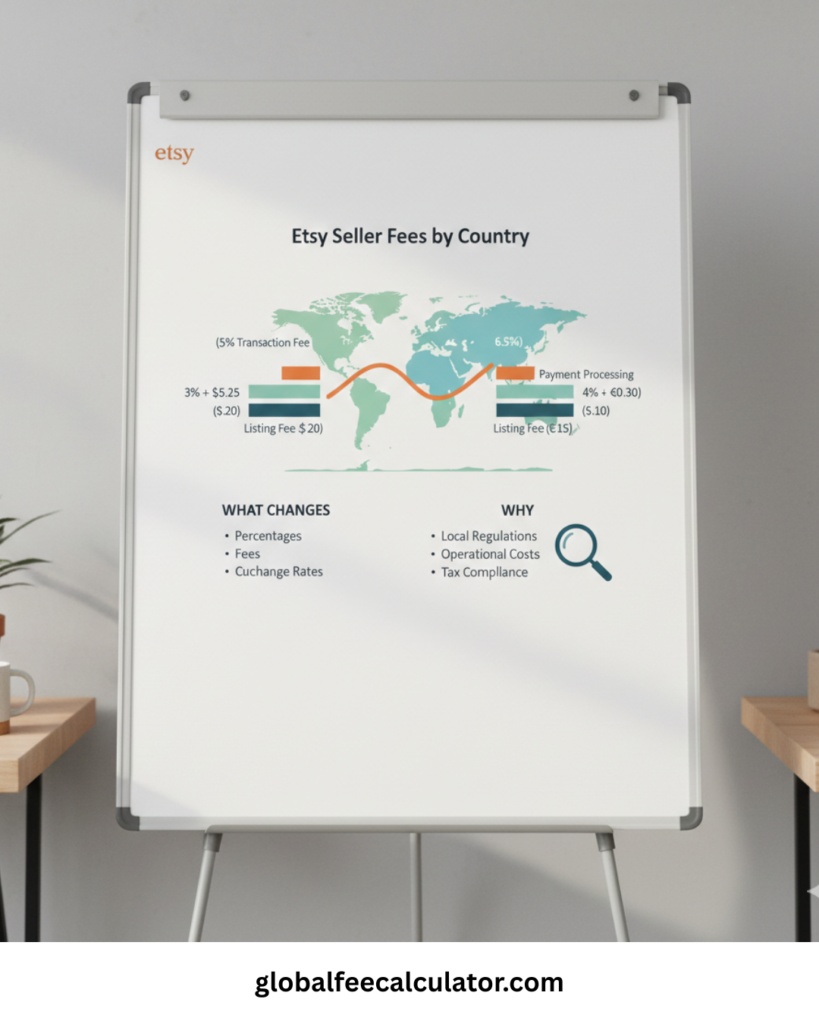
2. Transaction Fees by Country
What Transaction Fees Cover
Transaction fees are charged when you make a sale. They’re typically a percentage of:
The item’s sale price
Shipping and handling amounts (in some regions)
Any personalization or custom options
Country Differences in Transaction Fees
Most countries have a similar base rate for the transaction fee, but how it’s applied and what it includes varies:
Examples of Variation
Some countries charge the fee on the item price only
Others charge the fee on item + shipping + gift wrap
Some regions include sales tax before calculating fees
Others exclude tax from fee calculations
Because of this, two shops selling the same item at the same price could incur different effective transaction costs based on where the shop is registered.
Why These Differences Exist
Local consumer protection laws
Tax remittance requirements
Marketplace facilitator regulations
Banking and card network fee differences
For international sellers, these variations can affect net margins significantly.
3. Payment Processing Fees in Different Countries
What Payment Processing Fees Are
When Etsy processes a payment — meaning it handles the card authorization and funds transfer — it charges a processing fee.
This fee usually includes:
A percentage of the total order
A fixed amount per transaction
How Processing Fees Vary
Processing fees vary dramatically between countries, because:
Banks and card networks charge different rates by region
Local payment methods (e.g., iDEAL in the Netherlands, Bancontact in Belgium) have unique costs
Currency conversion may add extra percentage charges
Example Differences
In the USA, a common processing fee might be advertised as a certain percentage + fixed USD amount.
In the European Union, it might be a percentage + fixed EUR amount — but the percentage or fixed portion may be slightly different.
Notably, digital wallets and local payment methods can have different rates than standard card payments.
Why Etsy Doesn’t Use One Global Rate
Etsy uses Etsy Payments, which aggregates multiple payment methods and routes the payout to sellers. Because payment processing costs vary by region and method, the fees charged must reflect these local differences.
4. Currency Conversion Fees
What This Fee Means
If you sell in one currency but receive payouts in another, Etsy may apply a currency conversion fee when transferring funds.
For example:
A Canadian seller listing in CAD but receiving payouts in USD
A U.S. seller selling in EUR and having Etsy convert the balance to USD
International vs Local Sales
Currency conversion fees often apply only if:
The buyer pays in a different currency than your payout currency
Etsy needs to convert funds before depositing to your bank
Country-Specific Impacts
Some countries have stricter controls or higher costs around foreign currency conversion. Etsy may pass those costs through as conversion fees.
For international sellers, this fee is often “hidden” because it’s not shown as a separate line item — it’s reflected in the exchange rate used.
5. Advertising Fees by Country
Etsy Ads and Offsite Ads
Etsy offers:
Etsy Ads — Sponsored placements on Etsy search
Offsite Ads — Etsy uses external channels (Google, Facebook, Instagram, etc.) and charges a fee when it drives a sale
Variation in Advertising Fees
Etsy’s ad fees may vary by region because:
Cost of paid advertising differs by country
Competitive landscape affects click and conversion costs
Ad networks charge different rates in different markets
For example, an ad click in one country may cost more than in another, which affects overall returned revenue.
6. Tax and Regulatory Fee Differences
Marketplace Facilitator Laws
In the USA and many other countries, Etsy is required to collect and remit sales tax or VAT on behalf of sellers in specific regions.
This doesn’t change the fee Etsy charges, but it affects the amount buyers pay, which in turn affects:
Shipping cost calculations
Payment processing fee bases
Total order value subject to fees
EU, UK, and Other Regions
Many regions outside the U.S. operate similar tax laws (e.g., VAT in the EU/UK). Sellers must understand how taxes affect fee calculations and what portion of a buyer’s payment actually belongs to the seller.
Regional fee differences directly affect margins, which is why sellers should learn how to calculate Etsy seller profit after fees.
Example: How Fees Compare Between Two Countries
To illustrate, consider two sellers listing the same item at the same price in local currencies:
| Feature | Seller A (USA) | Seller B (UK) |
|---|---|---|
| Listing Fee | $0.20 USD | £0.15 GBP (equiv) |
| Transaction Fee | % on item + shipping | % (may include tax differently) |
| Processing Fee | % + fixed USD | % + fixed GBP |
| Currency Conversion | None | Rare (depending on payout) |
| Tax Handling | Marketplace facilitator remits sales tax | VAT inclusive pricing |
Even with similar base rates, differences in payment processing, tax inclusions, and currency handling result in different net payouts.
Country-Specific Etsy Fee Calculators
🇺🇸 United States – Etsy Fees Calculator USA
Sellers based in the United States should consider how transaction fees, payment processing rates, marketplace facilitator tax rules, and optional advertising costs affect net payouts. Because U.S. transaction fees often apply to item price and shipping, even small pricing adjustments can change profitability. U.S. sellers can use the Etsy Fees Calculator USA to estimate accurate net profit after listing fees, processing charges, and advertising deductions.
🇬🇧 United Kingdom – Etsy Fees Calculator UK
UK sellers operate within a VAT-inclusive pricing environment, which affects how transaction fees and payment processing costs are calculated. Because VAT handling and GBP-based processing fees differ from U.S. structures, net payouts can look different even when prices are similar. Sellers in the UK can use the Etsy Fees Calculator UK to calculate region-specific fees and understand real profit after deductions.
🇦🇺 Australia – Etsy Fees Calculator Australia
Australian Etsy sellers must account for AUD-based listing fees, payment processing differences, and GST considerations. Even small variations in fixed processing charges can influence margins on lower-priced products. Sellers in Australia can use the Etsy Fees Calculator Australia to estimate accurate net earnings based on local fee structures and currency settings.
🇨🇦 Canada – Etsy Fees Calculator Canada
Canadian sellers often face currency considerations when selling internationally, especially when listing in CAD but receiving payments in other currencies. Payment processing and currency conversion can affect final payouts more than expected. The Etsy Fees Calculator Canada helps sellers calculate region-specific fees and plan pricing more effectively.
🇪🇺 European Union – Etsy Fees Calculator EU (If you want generic EU section)
EU sellers operate under VAT regulations and region-specific payment processing rules, which influence how transaction fees and payouts are structured. Because VAT treatment varies slightly by country, understanding local fee calculations is essential. EU sellers can use the relevant country-based Etsy calculator to estimate net earnings more accurately.
🇫🇷 France – Etsy Fees Calculator France
Sellers in France must consider VAT-inclusive pricing, EUR-based listing fees, and regional processing costs. These factors affect both transaction fee calculation and net payout per order. French sellers can use the Etsy Fees Calculator France to evaluate profitability before adjusting pricing or launching ads.
🇩🇪 Germany – Etsy Fees Calculator Germany
German Etsy sellers operate within strict VAT and marketplace facilitator regulations. Because tax inclusion and payment processing fees differ slightly across regions, margins can vary even at similar price points. The Etsy Fees Calculator Germany helps sellers calculate local fee impact more precisely.
🇻🇳 Vietnam – Etsy Fees Calculator Vietnam
Sellers in Vietnam often face additional considerations such as international payout routing and currency conversion when receiving funds. Because cross-border processing may influence net revenue, understanding the full cost breakdown is critical. Vietnamese sellers can use the Etsy Fees Calculator Vietnam to estimate region-adjusted earnings.
🇧🇷 Brazil – Etsy Fees Calculator Brazil
Brazilian Etsy sellers may encounter currency conversion costs and regional banking differences that affect payout amounts. These differences make it important to calculate fees based on BRL pricing and international transaction structures. The Etsy Fees Calculator Brazil allows sellers to model local fee impact accurately.
🇹🇷 Turkey – Etsy Fees Calculator Turkey
Sellers in Turkey should account for TRY-based listing fees, potential currency fluctuations, and payment processing differences when estimating profit. Because currency conversion can influence final payout values, accurate modeling is essential. Turkish sellers can use the Etsy Fees Calculator Turkey to calculate realistic net margins.
🇰🇷 South Korea – Etsy Fees Calculator South Korea
South Korean sellers must consider KRW-based pricing, cross-border payment handling, and potential currency conversion when receiving payouts. These factors can subtly change the effective fee percentage. The Etsy Fees Calculator South Korea helps sellers forecast real profit before listing or adjusting pricing.
What Changes When Selling Internationally
When buyers from other countries purchase from you:
Your shop still pays Etsy fees based on your shop’s country settings, not the buyer’s location
But the payment processing component may vary based on the buyer’s card/region
Currency conversion may kick in
Cross-border card processing may have added costs
This means a U.S. seller can receive a U.S. Etsy fee rate but still see different net payouts because of how the buyer’s card is billed and currency is handled.
Common Mistakes Sellers Make With Country Fee Differences
1. Assuming Fees Are Identical Everywhere
Even though fee categories are consistent, the amounts and what’s included vary.
2. Ignoring Currency Conversion Impact
Sellers often forget that conversion affects net payout and can feel like an unseen fee.
3. Not Accounting for Local Tax Laws
Some regions embed tax in price differently, which affects fee calculations.
4. Pricing for One Market Only
Using a single price worldwide without adjusting for cost differences results in inconsistent margins.
Tools and Practices to Manage International Fee Differences
Recommended Practices
Set your shop currency and payout currency intentionally
Use Etsy’s fee preview or reporting tools
Review Etsy payouts rather than gross sales totals
Price products with all fees in mind
Track profitability per region if you sell globally
Recommended Tools
Etsy fee calculators (neutral tools that let you input country & price)
Spreadsheets for cost and fee breakdowns
Accounting software that supports multi-currency sales
These tools help you see net earnings before committing to pricing or ads strategies.
Final Summary
Etsy seller fees are consistent in structure, but they vary by country because of local currency, payment processing costs, tax laws, and marketplace rules. U.S. sellers, EU sellers, UK sellers, Australian sellers, and others all pay similar fee categories, but the actual amounts and how they’re calculated differ.
Understanding your country-specific fees is essential for:
Pricing products profitably
Planning international expansions
Avoiding margin surprises
Forecasting real net revenue
Fees shouldn’t be a mystery. When you break them down clearly and calculate fees based on your shop’s country settings, you gain control over margins rather than guess at profitability.
Frequently Asked Questions (FAQs)
1. Do Etsy fees differ by country?
Yes. While fee categories are similar, the exact amounts and how they’re applied vary based on your Etsy shop’s country.
2. Are VAT or sales taxes included in Etsy fees?
Etsy may collect or remit tax on your behalf, but the treatment of tax in fee calculations depends on local laws.
3. Do international buyers affect my Etsy fees?
Your shop’s country determines the fees, but payment processing and currency effects can change the net payout.
4. Is currency conversion a separate fee?
Yes. Currency conversion typically applies when your payout currency differs from the buyer’s payment currency.
5. Are advertising fees the same everywhere?
No. Advertising costs vary by region because of different ad network costs and competition.
6. How often should I review my fee structure?
Regularly—especially when entering new markets or Etsy updates fees in your country.
7. Do listing fees change by country?
The listing fee is conceptually the same but converted to local currency and may differ slightly.
8. Can I price differently for different countries?
You can list different prices in different currencies, which allows you to account for regional cost differences.
9. Why does my payout look lower than expected?
Multiple fees (including processing, transaction, currency conversion, and ads) are deducted before payout.
10. What’s the safest way to calculate Etsy fees?
Use a fee calculator designed for Etsy, inputting your shop country, payout currency, and product price.
Etsy Fee Calculators for Other Countries
If you sell internationally, you may also want to estimate Etsy seller fees in other markets:
Recommendation:
Always verify details directly on the official company website before making any business or financial decision.