
Many Etsy sellers focus on sales volume but overlook a critical detail: profit after fees. A product can sell consistently and still lose money once Etsy fees, payment processing costs, taxes, and production expenses are deducted. This is why understanding how to calculate Etsy seller profit after fees is essential for long-term success.
One of the most common mistakes sellers make is pricing products based on what competitors charge—without fully accounting for Etsy’s layered fee structure. Over time, these small miscalculations compound, quietly shrinking margins and limiting growth.
In this guide, you’ll learn exactly how Etsy fees work, how to calculate your true profit step by step, and how to avoid common pricing mistakes that cost sellers money.
Table of Contents
ToggleWhy Etsy Profit Calculation Is Often Misunderstood
Etsy fees are not deducted in one place or at one time. Instead, they are applied at different stages of the selling process, which makes it easy to underestimate total costs.
Many sellers:
Look only at Etsy deposits instead of full fee breakdowns
Forget to include offsite ads or payment processing fees
Ignore packaging, shipping, and production costs
Assume small fees don’t significantly affect profit
Accurate profit calculation requires looking beyond surface-level numbers.
Before calculating profit, it’s important to understand how Etsy fees work across listings, transactions, and payments.
Understanding Etsy’s Core Fees
Before calculating profit, you must understand every fee that may apply to a sale.
Listing Fee
Etsy charges a small fee for each product listing, valid for a set period or until the item sells. Even if an item doesn’t sell, this fee still applies.
Transaction Fee
A percentage-based fee is applied to the item price, including any personalization or add-ons. This fee increases as your product price increases.
Payment Processing Fee
When a customer pays through Etsy Payments, Etsy deducts a processing fee. This includes:
A percentage of the total order
A fixed per-transaction charge
This fee is unavoidable for most sellers.
Offsite Ads Fee (If Applicable)
If Etsy brings a buyer through offsite advertising, an additional percentage fee may apply. This fee can significantly reduce margins if not planned for.
Currency Conversion Fee
If you sell internationally and list prices in one currency while receiving payouts in another, Etsy applies a currency conversion fee. Profit calculations become more accurate when you account for Etsy fees that vary by country and region.
Regulatory and Tax-Related Fees
Depending on your location, Etsy may charge additional regulatory or marketplace facilitator fees.
Costs Etsy Does Not Track for You
Etsy’s dashboard does not show your true profit because it does not include your business costs.
These include:
Product manufacturing or material costs
Packaging supplies
Shipping expenses not charged to buyers
Marketing or branding costs
Subscription tools or design software
Labor or time-based expenses
Ignoring these costs gives a misleading view of profitability.
Step-by-Step: How to Calculate Etsy Seller Profit
Here’s a simple, accurate method.
Step 1: Start With Your Product Sale Price
This is the amount the buyer pays before fees.
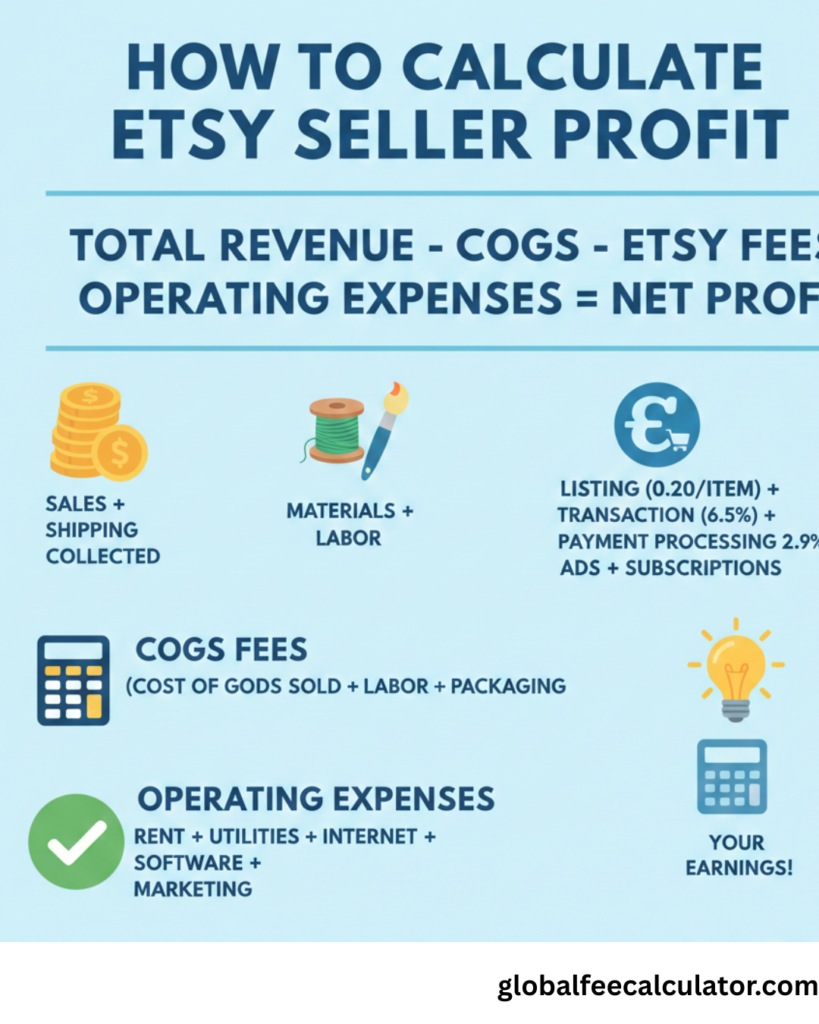
Step 2: Subtract All Etsy Fees
Include:
Listing fee (allocated per sale)
Transaction fee
Payment processing fee
Offsite ad fee (if triggered)
Currency conversion or regulatory fees
This gives you your net Etsy payout before expenses.
Step 3: Subtract Product Costs
Deduct:
Materials or production costs
Packaging
Shipping costs you cover
Step 4: Subtract Operational Expenses
Estimate per-item costs for:
Marketing
Tools and subscriptions
Labor or fulfillment time
Step 5: The Final Number Is Your True Profit
If this number is lower than expected—or negative—it’s a sign your pricing needs adjustment.
While manual math works, using a tool to calculate Etsy fees accurately makes profit estimation much easier.
Example Profit Calculation
Imagine selling a handmade item for a mid-range price.
After Etsy deducts listing, transaction, and payment processing fees, the payout is already reduced. If offsite ads apply, the margin shrinks further. Once you subtract production, packaging, and shipping, many sellers discover their real profit is far lower than expected.
This is why relying on gross sales numbers is misleading
Common Etsy Profit Calculation Mistakes
Ignoring Offsite Ads Impact
Some sellers don’t realize offsite ad fees apply until margins drop suddenly.
Using One Price for All Regions
International orders often cost more due to currency and processing fees.
Forgetting Listing Fees Over Time
Relisted items accumulate costs even if sales are slow.
Not Tracking Packaging and Shipping Inflation
Rising material and shipping costs quietly eat into profit.
How Accurate Profit Calculation Improves Pricing Strategy
When you know your real profit per item, you can:
Set minimum viable prices
Offer discounts without hurting margins
Scale products that actually make money
Stop selling items that only create revenue, not profit
This shifts your business from guessing to informed decision-making
Sellers who want a deeper breakdown of individual charges can review Etsy fee calculations explained step by step.
Recommended Tools to Reduce Etsy Fee Impact
Fee Calculators
Useful for estimating fees and profit margins before listing or updating prices.
Expense Tracking Spreadsheets
Helps monitor material, packaging, and operational costs over time.
Pricing Review Templates
Allow sellers to re-evaluate older listings that may no longer be profitable.
These tools don’t reduce fees directly—but they prevent costly pricing mistakes
Once profit is clear, sellers can explore ways to reduce Etsy fees legally to protect margins.
Final Summary
Calculating Etsy seller profit after fees is not optional—it’s essential. Etsy’s layered fee system, combined with real-world business expenses, means gross sales numbers rarely reflect true earnings.
By understanding every fee, tracking all costs, and calculating profit accurately, sellers can price smarter, protect margins, and build sustainable businesses instead of chasing sales volume alone.
If you sell from the United Kingdom, make sure you understand the UK specific Etsy fee structure before estimating your margins.
Profit calculations are especially important when comparing Etsy and Shopify fee structures.
Frequently Asked Questions (FAQs)
1. Does Etsy show my actual profit?
No. Etsy shows payouts, not true profit after expenses.
2. Are Etsy fees deducted before or after shipping?
Fees are typically calculated based on item price and applicable charges, depending on the fee type.
3. Do offsite ads always apply?
No. They only apply when Etsy brings a buyer through external advertising.
4. Are listing fees charged even if an item doesn’t sell?
Yes. Listing fees apply whether or not a sale occurs.
5. Why does my payout seem lower than expected?
Multiple fees and processing costs are deducted at different stages.
6. Should I include my time as a cost?
Yes. Labor is a real business expense that affects profitability.
7. Is international selling less profitable?
It can be if currency conversion and higher fees aren’t priced in.
8. How often should I recalculate profit?
At least quarterly, or whenever Etsy updates fees or your costs change.
9. Can a fee calculator replace bookkeeping?
No. It helps estimate profit but doesn’t replace proper accounting
Recommendation:
Always verify details directly on the official company website before making any business or financial decision.