
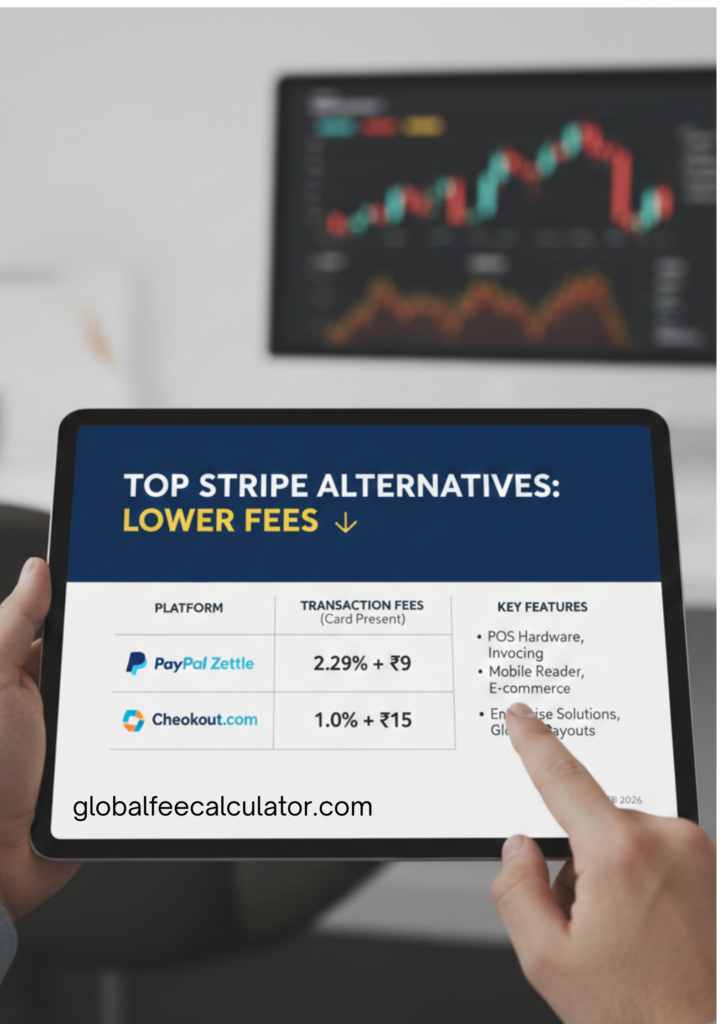
Stripe is one of the most widely used payment processors for online businesses, SaaS platforms, and global sellers. Known for its developer-friendly APIs and support for international payments, Stripe makes it easy to accept cards, wallets, and recurring payments across multiple countries. However, while its flat-rate pricing model offers simplicity, many businesses underestimate how Stripe’s transaction fees, international charges, currency conversion costs, and add-on services can quietly reduce profit margins over time.
Understanding how Stripe’s fee structure works is essential before deciding whether it’s the most cost-effective option—or if alternatives with lower effective fees may better suit your business model.
Before comparing alternatives, it’s important to understand how Stripe fees work, as this provides a baseline for evaluating other payment processors.
Table of Contents
ToggleBest Stripe Alternatives with Lower Fees
1) Helcim – Interchange-Plus Pricing (Lower Effective Fees)
Why it’s different:
Helcim uses an interchange-plus pricing model, meaning you pay actual card network costs (interchange) plus a small markup. As your monthly volume grows, Helcim automatically reduces fees—something Stripe doesn’t do with flat pricing.
Real-world impact:
-
Online transactions often run closer to ~2.27% + $0.25†, noticeably lower than Stripe’s standard 2.9% + $0.30.
-
In-person rates can be even lower (e.g., ~1.83% + $0.08).
-
Volume discounts kick in above certain thresholds, making it especially cost-effective at scale (e.g., >$50K/month).
Best for: Businesses with medium to high sales volume that want predictable, decreasing processing costs.
2) Stax – Zero Markup Interchange Fees (High Volume + Subscription Model)
How it works:
Instead of a percentage on every transaction, Stax charges a flat monthly fee (often starting around ~$99) and then passes through interchange rates with little to no markup.
Why this matters:
On $10,000 in sales, Stripe might take ~$290 in fees, but with Stax’s approach the fees can drop dramatically once the monthly subscription cost is covered in savings.
Best for:
Established businesses with consistent monthly processing volume that want the lowest possible effective fee per transaction.
3) Braintree – PayPal-Owned With Flexible, Competitive Fees
Key points:
Braintree (owned by PayPal) offers transaction fees competitive with standard gateways and includes features such as free fraud tools and built-in recurring billing.
Why choose it:
-
Strong for merchants who want PayPal integration alongside card processing
-
Free advanced features (fraud tools, subscriptions) that might cost extra elsewhere
-
Lower effective costs than basic PayPal business accounts
Best for: Sellers who want a blend of reliability, features, and lower fees than traditional PayPal processing.
4) Adyen – Enterprise-Grade, Low Percentage Fees
While more common with larger merchants, Adyen offers pricing that can be lower per transaction than Stripe, especially when processing large volumes.
Example approach:
-
Adyen’s model can be closer to interchange + a small fixed component, e.g., ~0.6% + $0.12 for some cards (varies by region and volume).
Best for: Mid-to-large ecommerce or SaaS businesses with global sales and the ability to pay platform or account minimums.
Some alternatives stand out because they offer lower transaction fees than traditional flat-rate processors.
Other Low-Fee Considerations
ACH & Bank-to-Bank Transfers
-
Bank (ACH) transfers often cost a fraction of card fees (sometimes under $1 per transaction). Many businesses use this for subscriptions or high-ticket sales to save margin.
Region-Specific Alternatives (Example: India)
For exports and cross-border payments, platforms like Razorpay MoneySaver, Skydo, and Infinity offer much lower all-in costs than Stripe in certain markets (e.g., lower forex markup and reduced transaction fees).
Many alternatives differ primarily in pricing approach, which makes it useful to review Stripe pricing models before comparing other providers.
When Stripe Is Still the Right Choice Despite Higher Fees
This builds trust and balance.
It explains that Stripe may still make sense for:
-
Early-stage startups
-
Businesses needing advanced APIs
-
Companies valuing speed and integrations over cost
Balanced content improves credibility.
Using a tool to calculate Stripe fees accurately helps businesses compare real costs before deciding whether an alternative makes sense.
Things to Consider Before Switching
-
Integration flexibility: Stripe’s developer-friendly APIs are hard to match; cheaper alternatives may offer fewer customization options.
-
Feature set: Cheaper fees sometimes come with fewer built-in tools (e.g., advanced fraud detection or nuanced subscription billing).
-
Volume thresholds: Some alternatives are only cheaper once your business reaches moderate or high transaction volume.
-
Market specifics: Fees and services vary widely by region and merchant type.
Summary — Alternatives with Lower Cost Potential
Best overall for lower fees:
-
Helcim – Low transaction costs with volume-based pricing
-
Stax – Great for high volume with interchange-only costs
-
Braintree – Competitive pricing with valuable features
Specialized or bundled fee models:
-
Adyen – Enterprise and global merchants
-
Payhip / Lemon Squeezy – Creator-friendly bundles including compliance
Choosing the right alternative depends on your transaction volume, sales geography, and business model. If fees are a major margin concern, consider processors that use interchange-plus pricing or flat monthly fee models rather than pure percentage-based charges.
For businesses operating globally, comparing alternatives alongside Stripe international fees can highlight where cost differences really come from.
FAQs: Best Stripe Alternatives With Lower Fees
1. Are there payment processors cheaper than Stripe?
Yes. Some processors using interchange-plus or subscription pricing models can result in lower effective fees, especially for businesses with steady or high transaction volumes.
2. Why does Stripe feel expensive as a business grows?
Stripe’s flat-rate pricing does not automatically decrease as volume increases, which means higher-volume businesses may pay more than necessary compared to negotiated or interchange-based models.
3. What is interchange-plus pricing?
Interchange-plus pricing separates card network fees from the processor’s markup, offering more transparency and often lower overall costs than flat-rate pricing.
4. Are lower-fee Stripe alternatives safe and legitimate?
Yes. Many alternatives are regulated payment processors used by established businesses. Lower fees usually come from different pricing models, not reduced security.
5. Is switching away from Stripe difficult?
It depends on your setup. Simple ecommerce stores can switch easily, while SaaS or custom integrations may require development time and testing.
6. Do Stripe alternatives support international payments?
Some do, but international support varies by provider. Businesses selling globally should compare cross-border fees, currency conversion rates, and payout options carefully.
7. Can Stripe fees be negotiated?
In some cases, high-volume businesses can receive custom pricing from Stripe, but this typically requires consistent, significant transaction volume.
8. Are Stripe alternatives better for subscriptions?
Some alternatives include built-in subscription tools at no extra cost, which can reduce total expenses compared to paying separately for add-ons.