
Selling on Etsy can be an excellent way to build an online business, reach global customers, and monetize handmade, vintage, or digital products. However, before launching a shop or scaling an existing store, it is essential to understand how Etsy’s fee structure works.
Many new sellers focus only on the listing fee or transaction fee, but Etsy actually charges several types of fees that combine to affect your real profit per sale. These include listing fees, transaction fees, payment processing charges, optional advertising fees, regulatory fees, and sometimes currency conversion fees.
Understanding these fees helps sellers set accurate product prices, protect profit margins, and avoid surprises in their Etsy payouts.
This complete Etsy Fees Guide for 2026 explains:
• All major Etsy fee types
• How Etsy calculates seller costs
• How fees differ across countries
• How to calculate real profit after Etsy fees
• Which tools can help estimate Etsy costs before listing products
If you want a detailed explanation of how the platform charges sellers, you can also read our full Etsy Fees Explained guide, which breaks down listing fees, transaction charges, and hidden costs in more detail
Table of Contents
ToggleOverview of Etsy Seller Fees
Etsy’s business model is built around charging small fees for listing products and processing sales on the marketplace. These fees allow Etsy to maintain the platform, process payments, and promote listings to buyers.
Although the fee structure looks simple at first, multiple fee layers can apply to each order.
The most common Etsy seller fees include:
• Listing fees
• Transaction fees
• Payment processing fees
• Offsite Ads fees
• Regulatory operating fees
• Currency conversion fees
Depending on your location and how you run your shop, these combined costs typically represent 10% to 20% of the total order value.
Understanding each fee type individually helps sellers calculate accurate pricing and maintain sustainable profit margins.
Etsy Listing Fees
The listing fee is one of the most basic charges Etsy sellers encounter.
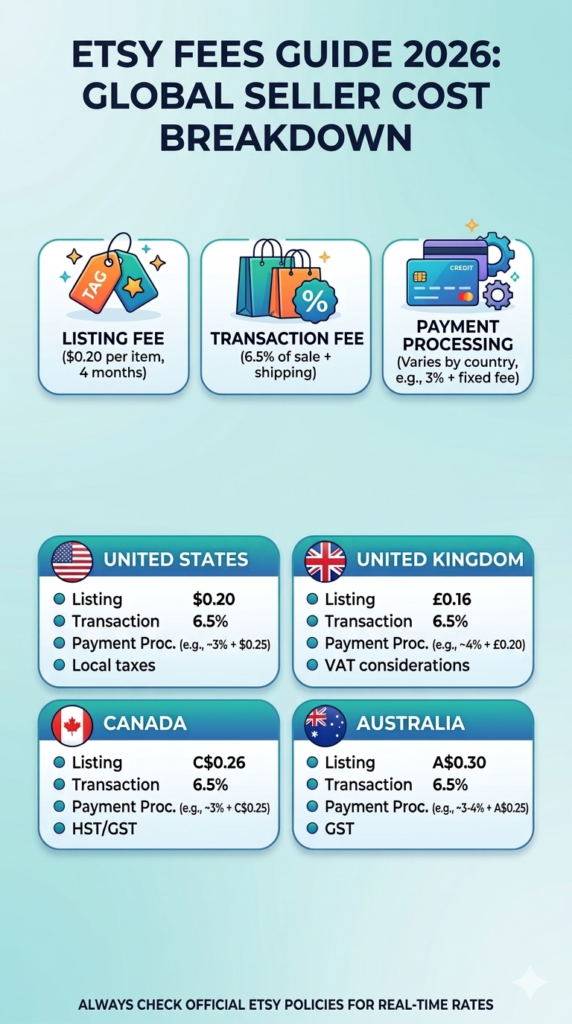
Etsy charges $0.20 USD per listing when a product is published on the platform.
Key points about Etsy listing fees:
• Each listing remains active for four months or until the item sells
• If the item sells, Etsy charges a new listing fee for the next quantity sold
• Auto-renew listings automatically renew every four months unless turned off
Although $0.20 may seem small, listing fees can accumulate quickly if a shop maintains hundreds of active products.
Sellers with large inventories should periodically review listings that are not performing well to avoid unnecessary listing renewals.
Etsy Transaction Fees
When a product sells on Etsy, the platform charges a transaction fee of 6.5%.
This percentage applies to the total order value, which includes:
• Product price
• Shipping charges
• Gift wrapping (if applicable)
Because the transaction fee applies to the full order amount, shipping costs can increase the total Etsy fees deducted from each sale.
For example:
If a seller lists an item for $40 and charges $10 for shipping, the 6.5% transaction fee is calculated on $50, not just the product price.
This is why many Etsy sellers include shipping costs within their product pricing strategy.
Etsy Payment Processing Fees
Etsy uses a system called Etsy Payments to process buyer transactions.
This payment system supports credit cards, debit cards, PayPal, Apple Pay, Google Pay, and other local payment methods.
Payment processing fees vary slightly by country.
Typical processing rates include:
• USA: around 3% + $0.25 per order
• UK: around 4% + £0.20 per order
• Australia: around 3.5% + AU$0.25 per order
• Germany and EU: around 4% + €0.30 per order
These charges cover payment gateway costs, card network processing, and fraud prevention.
When combined with the transaction fee, payment processing charges form a significant portion of Etsy’s total platform fees.
Etsy Offsite Ads Fees
Etsy also offers an advertising program called Offsite Ads.
Through this program, Etsy promotes listings on external platforms such as:
• Google Shopping
• Facebook
• Instagram
• Pinterest
• Display advertising networks
If a buyer clicks an Etsy ad and purchases a product within a certain time window, Etsy charges an additional advertising fee.
Typical Offsite Ads rates include:
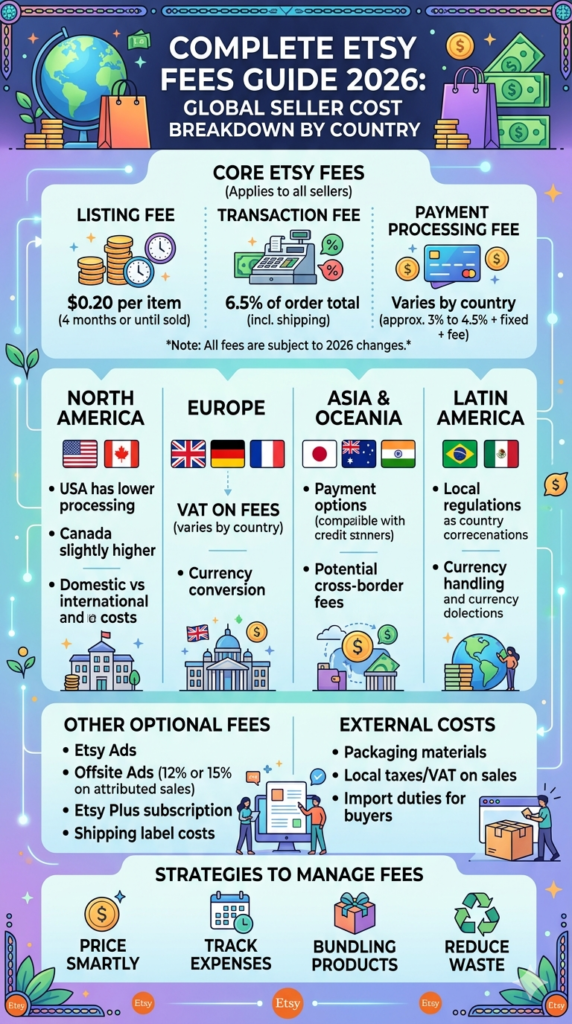
• 15% per order for most sellers
• 12% per order for high-volume shops
This fee is only charged when a sale occurs from an ad click.
While Offsite Ads can increase visibility and sales, sellers should factor this additional cost into their pricing strategy.
Etsy Regulatory Operating Fees
In certain countries, Etsy applies an additional regulatory operating fee.
This small percentage covers compliance costs associated with operating in specific regions.
Countries where this fee may apply include:
• United Kingdom
• European Union markets
• Some international seller locations
The regulatory operating fee is usually around 0.25% to 0.32% of the order value.
Although relatively small, it still contributes to the overall Etsy cost structure.
Currency Conversion Fees
Currency conversion fees may apply when the currency used for listings differs from the seller’s payout currency.
For example:
• A seller lists products in USD but receives payouts in EUR
• Etsy must convert funds between currencies
In these cases, Etsy typically charges around 2.5% for currency conversion.
Sellers who list and receive payouts in the same currency can usually avoid these fees.
How Much Does Etsy Take From Sellers?
When all Etsy platform fees are combined, sellers often pay between 10% and 20% of the total order value.
The exact percentage depends on factors such as:
• Shipping costs
• Payment processing fees
• Advertising participation
• Currency conversion
• Country-specific regulations
For example:
A $50 order may include:
Transaction fee: $3.25
Processing fee: $1.75
Listing fee: $0.20
Total Etsy fees: approximately $5.20
This means the seller receives about $44.80 before product costs and shipping materials.
Because of this, understanding Etsy’s fee structure is essential when setting product prices
Etsy Seller Fees by Country (Global Comparison)
Although Etsy’s core platform fees remain similar worldwide, the exact cost of selling can vary depending on the seller’s country. Payment processing fees, regulatory operating charges, and currency conversion costs differ slightly across regions.
For example, sellers in the United States, United Kingdom, Canada, Australia, and European Union markets all pay the standard 6.5% transaction fee, but payment processing charges are calculated differently depending on local banking infrastructure and card network costs.
Below is a simplified comparison of Etsy seller fees in several major markets.
| Country | Listing Fee | Transaction Fee | Processing Fee |
|---|---|---|---|
| United States | $0.20 | 6.5% | ~3% + $0.25 |
| United Kingdom | £0.15 | 6.5% | ~4% + £0.20 |
| Canada | $0.20 USD | 6.5% | ~3% + $0.25 CAD |
| Australia | AU$0.30 | 6.5% | ~3.5% + AU$0.25 |
| Germany | €0.17 | 6.5% | ~4% + €0.30 |
Although the transaction fee remains consistent globally, payment processing costs can slightly increase or decrease the total platform deduction depending on the seller’s location.
For example, sellers in Europe often pay slightly higher processing fees because of regional card regulations, while some markets benefit from lower domestic card processing rates.
Another factor that can affect seller costs is currency conversion. Sellers who list products in one currency but receive payouts in another may incur additional conversion fees when Etsy transfers funds.
Because of these differences, sellers operating internationally should review country-specific fee structures before expanding their shop to new markets.
To help sellers estimate their real profit margins, we provide country-specific Etsy fee calculators for different regions.
Use the calculator relevant to your market:
- Etsy Fee Calculator Australia
- Etsy Fee Calculator Brazil
- Etsy Fee Calculator Canada
- Etsy Fee Calculator France
- Etsy Fee Calculator Germany
- Etsy Fee Calculator UK
- Etsy Fee Calculator USA
- Etsy Fee Calculator Turkey
- Etsy Fee Calculator South Korea
- Etsy Fee Calculator Vietnam
These tools allow sellers to estimate total Etsy platform fees and understand their net earnings before publishing listings or adjusting product prices.
How to Calculate Etsy Profit After Fees
Many Etsy sellers make the mistake of calculating profit based only on product cost and selling price.
However, a more accurate formula should include Etsy platform fees as well.
A simplified profit formula looks like this:
Profit = Selling Price − Etsy Fees − Product Cost − Shipping Cost
For example:
Selling price: $50
Etsy fees: $5.20
Product cost: $15
Shipping materials: $5
Final profit: $24.80
Using a fee calculator before listing products helps sellers understand their true profit margins.
You can also read our detailed guide on how to calculate Etsy profit after fees to learn how successful sellers price their products strategically.
Why Understanding Etsy Fees Is Important for Sellers
Understanding Etsy’s fee structure is critical for several reasons.
First, accurate pricing protects profit margins. Sellers who underestimate platform costs often price products too low and struggle to remain profitable.
Second, calculating fees helps sellers decide which products are worth listing. Some products with low margins may not be viable once Etsy fees are applied.
Third, understanding fees allows sellers to plan advertising strategies and international expansion more effectively.
Successful Etsy businesses always calculate their total platform costs before scaling operations.
Tips for Reducing Etsy Seller Fees
Although Etsy’s core fees cannot be removed, sellers can take steps to reduce their effective cost per order.
Common strategies include:
Optimize pricing to include shipping costs within product prices
Bundle products together to increase average order value
Review auto-renew listings to avoid unnecessary listing fees
Monitor Offsite Ads participation to ensure advertising costs remain profitable
Evaluate currency settings to minimize conversion charges
These strategies help sellers maintain sustainable margins while still benefiting from Etsy’s global marketplace.
Hidden Etsy Fees Many Sellers Overlook
While Etsy’s basic fees are widely known, many sellers underestimate several additional costs that can affect their real earnings. These “hidden” fees are not necessarily secret, but they are often overlooked when calculating product pricing.
Understanding these extra costs is important for maintaining healthy profit margins.
Shipping Fee Impact
One of the most common surprises for Etsy sellers is that the transaction fee applies to the entire order value, including shipping costs.
For example:
If a seller lists an item for $40 and charges $10 for shipping, Etsy calculates the 6.5% transaction fee on $50, not just the product price.
Because of this, many experienced sellers include shipping costs in their product price instead of listing shipping separately.
Offsite Advertising Fees
Etsy’s Offsite Ads program can generate additional sales by promoting listings across external platforms such as Google Shopping, Facebook, and Pinterest.
However, if a customer clicks one of these ads and purchases a product, Etsy may charge an additional advertising fee.
This fee is typically:
• 15% per order for most sellers
• 12% per order for high-volume shops
Although this program can help increase visibility, sellers should factor this potential cost into their pricing strategy.
Currency Conversion Charges
Currency conversion fees may apply when Etsy converts funds between currencies during payouts.
For example, a seller who lists products in USD but receives payouts in EUR may incur a 2.5% currency conversion fee.
Sellers who operate internationally or accept buyers from multiple regions should monitor how currency settings affect their payouts.
Auto-Renew Listing Fees
Etsy listings automatically renew every four months if auto-renew is enabled.
Each renewal triggers another $0.20 listing fee, even if the product has not sold.
For sellers with large inventories, this can gradually increase listing costs over time.
Regularly reviewing underperforming listings helps prevent unnecessary renewal fees.
Refund and Dispute Costs
Although Etsy does not charge a fee for issuing refunds, payment processing fees may not always be returned depending on the payment provider and situation.
Additionally, chargebacks or payment disputes may involve additional administrative costs.
For sellers handling high transaction volumes, these small costs can accumulate over time.
Why Understanding All Etsy Fees Matters
Many new Etsy sellers focus only on the visible platform fees when calculating pricing. However, real profit depends on accounting for every cost associated with a sale.
These costs include:
• Etsy platform fees
• production expenses
• packaging materials
• shipping supplies
• advertising costs
• payment processing fees
Successful Etsy businesses treat these costs as part of their pricing model rather than unexpected deductions.
Using tools like Etsy fee calculators and profit estimators helps sellers understand their real earnings before listing products or launching new items.
By planning for these costs in advance, sellers can build sustainable pricing strategies and grow profitable Etsy shops.
Frequently Asked Questions
How much does Etsy charge sellers?
Etsy typically charges a $0.20 listing fee, a 6.5% transaction fee on the total order value, and a payment processing fee that varies by country. Additional fees such as Offsite Ads or currency conversion may also apply.
Does Etsy charge fees on shipping?
Yes. Etsy’s transaction fee is calculated on the total order value, including the product price and shipping charges.
Are Etsy fees the same worldwide?
The basic platform fees are similar globally, but payment processing rates, regulatory fees, and currency conversion costs can vary by country.
How can sellers calculate Etsy fees before listing products?
Sellers can use an Etsy fee calculator to estimate total platform costs and net profit before publishing listings.
Do Etsy sellers need to pay advertising fees?
Advertising fees only apply if a sale occurs through Etsy’s Offsite Ads program. If no sale results from an ad click, the seller does not pay the advertising fee.
Can Etsy fees change over time?
Yes. Etsy occasionally updates its fee structure or payment processing policies, so sellers should periodically review Etsy’s official seller documentation.
Final Thoughts
Etsy provides a powerful platform for entrepreneurs to build online businesses and reach customers around the world. However, understanding the full Etsy fee structure is essential before launching products or scaling a shop.
Listing fees, transaction fees, payment processing charges, advertising fees, and regulatory costs all contribute to the total cost of selling on Etsy.
By calculating these fees in advance, sellers can price products correctly, protect profit margins, and make smarter business decisions.
Using Etsy fee calculators and reviewing fee structures by country can help sellers operate more efficiently and grow profitable Etsy shops in 2026 and beyond.