
For online sellers and digital businesses, payment processing fees directly affect profitability. Two of the most common choices are Stripe and PayPal, and while both offer easy ways to accept payments online, their pricing structures differ in meaningful ways.
This comparison breaks down the real cost differences—so you can decide more confidently which processor may be cheaper for your business based on your model, transaction types, and customer base.
Table of Contents
ToggleHow Stripe and PayPal Charge Fees
Common Ground
Both Stripe and PayPal use a transaction-based pricing model: you only pay when you process a payment. There are typically no monthly minimums or mandatory software subscriptions for basic processing.
However, the details beneath that broad similarity matter.
Basic Online Transaction Fees
Stripe
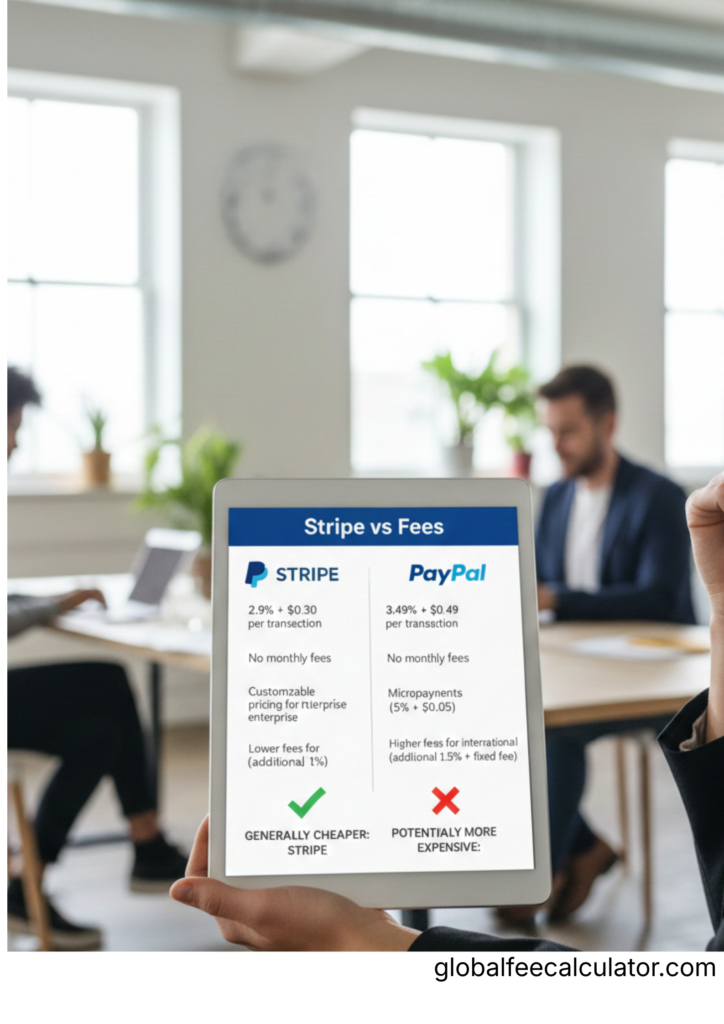
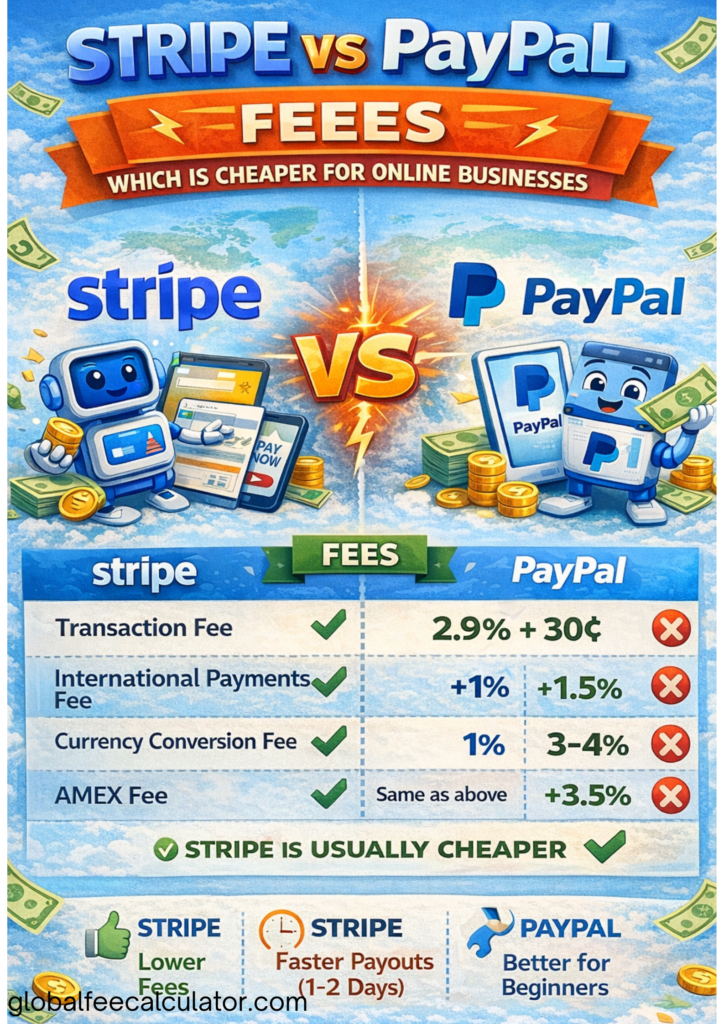
Standard online card payments: 2.9% + $0.30 per transaction (U.S. pricing).
Stripe’s fee is consistent across most online card and wallet payments. There’s usually no range—just one predictable rate. Stripe’s fee is charged on each successful transaction.
PayPal
Typical online payments range from ~2.29% to 3.49% + $0.49 per transaction depending on how customers pay and how you accept the payment.
This means PayPal’s rate varies more based on checkout method (e.g., standard vs. guest checkout) and location, which can make fee prediction less straightforward.
General Rule: For straightforward ecommerce card payments, Stripe’s flat fee tends to be lower or easier to predict than PayPal’s broader range.
Fixed Fees and Its Impact
PayPal’s flat fee (often around $0.49) is notably larger than Stripe’s $0.30 per transaction in many markets. Because of this:
On smaller sales, PayPal’s fixed cost is a larger share of revenue
Stripe’s lower fixed fee tends to help keep the effective fee percentage lower on modest ticket sizes
Example (illustrative):
On a $50 sale:
Stripe might cost ~$1.75
PayPal could cost closer to ~$2.00+ depending on exact rates
The difference adds up over many transactions.

International and Cross-Border Fees
For global sellers, how each processor handles international payments matters.
Stripe
Stripe adds a cross-border fee (often ~1%) on top of the baseline rate for cards issued abroad.
Currency conversion usually adds roughly 1–2% on top of the transaction cost.
PayPal
PayPal also applies additional international/cross-border fees (often ~1.5%) plus higher currency conversion markups (typically ~3–4%).
In practice on international receipts, many sellers find Stripe’s total fee (transaction + cross-border + conversion) is lower than PayPal’s combined charges. One regional example estimated Stripe’s all-in cost around ~6.3% versus PayPal’s ~8–9% on a large payment.
Takeaway: If you sell internationally often, Stripe frequently ends up cheaper after adding cross-border and currency fees—especially once you model real payouts rather than just the headline rate
Chargebacks and Dispute Fees
When customers dispute charges (and your business wins or loses), both processors charge a fee:
Stripe typically charges $15 per dispute.
PayPal’s dispute fee is often $20 (depending on service used).
This means on disputes, Stripe’s direct cost per case is usually lower, though the overall financial impact still depends on your dispute volume and resolution success.
Micropayments
If your average transaction is very small (e.g., micropayments under $10), standard fees take a disproportionate slice of revenue.
Here, the processors differ in policy:
Stripe often keeps the same 2.9% + fixed fee even for micropayments.
PayPal offers a micropayment pricing tier (for some accounts) at rates like 5% + $0.05.
At very small ticket sizes, neither standard rate is great—but PayPal’s dedicated micropayment structure may marginally help tiny transactions.
Subscription and Recurring Fees
If you’re running a SaaS or recurring billing model:
Stripe does not charge extra for subscription tools—subscription billing is part of its core pricing. Some advanced features like Radar fraud protection are included.
PayPal may charge additional monthly fees for advanced recurring billing tools depending on the plan.
This means Stripe often has an operational advantage for recurring revenue models, although exact pricing depends on which PayPal tier you choose.
When One Might Be Cheaper Than the Other
Here’s a general sense of fee dynamics based on common business scenarios:
When Stripe tends to be cheaper
Consistent online card payments at scale thanks to predictable rates
International sales, where PayPal’s higher FX fees add up
Recurring billing without monthly add-ons
High transaction volume, where Stripe can offer custom pricing
When PayPal might make sense
Businesses with very small transaction volumes and limited international revenue
Micropayments under special pricing tiers (if available)
Things Beyond Fee Rates That Affect Costs
1. Chargebacks and refunds
Both processors keep the processing fee on refunds, so frequent refunds reduce profitability. Chargeback fee differences can matter at scale.
2. Settlement and payout timing
Even with similar fees, delays in transferring funds to your bank can affect cash flow. Policies vary by region.
3. Add-ons and feature costs
Advanced fraud protection, invoicing tools, and premium features sometimes cost extra on PayPal but are included with Stripe’s core tools.
Before comparing external payment processors, review UK Etsy seller costs to understand the full platform fee impact.
Final Summary
When comparing Stripe vs PayPal fees for online businesses:
Stripe generally has lower and more predictable processing costs for standard ecommerce transactions (especially with international sales) and subscription billing.
PayPal can be more expensive per transaction, particularly with its higher fixed fee and conversion markups—but it may be easier to start with and familiar for customers.
Which is cheaper depends on your business model, average ticket size, and how much of your sales are international.
For many online sellers who prioritize margin and predictable costs, Stripe tends to be more cost-effective, while PayPal’s brand recognition and broad customer base can still be valuable—even if fees are generally higher.
Frequently Asked Questions (FAQs)
1. Is Stripe always cheaper than PayPal?
Not always, but for many standard ecommerce and international use cases, Stripe’s fees are lower.
2. Do both platforms charge monthly fees?
Basic payment processing doesn’t require monthly fees, though PayPal’s advanced services may have optional monthly costs.
3. Which processor is better for international sales?
Stripe’s lower currency conversion and cross-border fees often make it cheaper for global transactions.
4. Are micropayments cheaper on PayPal?
PayPal offers a special micropayment tier that can help very small transactions, but it depends on eligibility.
5. Do both platforms charge for refunds?
Yes—neither typically returns the original processing fees on refunds.
6. Is it worth offering both Stripe and PayPal at checkout?
Many sellers do this to give customers choice and maximize conversions. It can be worth it even if PayPal fees are somewhat higher.
7. Can I negotiate lower fees with Stripe or PayPal?
High-volume businesses may be eligible for custom pricing with either provider