

Selling internationally opens the door to more customers, higher revenue potential, and global brand growth. But for many online sellers, founders, and small businesses, international sales also introduce a less visible challenge: Stripe international fees.
At first glance, Stripe’s pricing looks simple. Many sellers plan around the standard domestic rate and assume international transactions work the same way. In reality, cross-border payments involve additional layers of fees that can quietly reduce margins if they’re not understood upfront.
Common issues global sellers face include:
Underpricing products for international customers
Ignoring currency conversion and cross-border card costs
Confusion about why payouts are lower than expected
This guide explains Stripe international fees in plain language, shows how they impact profitability, and outlines practical, legal ways to manage them. The goal is not to avoid fees, but to price smarter and sell globally with clarity.
Table of Contents
ToggleHow Stripe Handles International Payments
Stripe processes international transactions when either:
-
The customer’s card is issued in a different country than your business
-
The transaction involves currency conversion
Each scenario triggers additional costs beyond standard domestic fees.
Understanding how these fees are applied helps global sellers avoid unpleasant surprises after payout
Core Stripe Fees for International Transactions
Stripe international fees are not a single charge. They usually appear as a combination of the following.
Base Transaction Fee
Every Stripe payment starts with the standard processing fee:
-
A percentage of the transaction value
-
A fixed fee per successful charge
This base fee applies to both domestic and international payments.
International Card Fee
When a customer uses a card issued outside your business’s country, Stripe applies an international card surcharge.
Key points:
-
This fee is added on top of the standard processing fee
-
It applies even if the customer pays in your local currency
-
Many sellers overlook it because the payment still “looks local”
For global sellers, this fee becomes more noticeable as international sales volume increases.
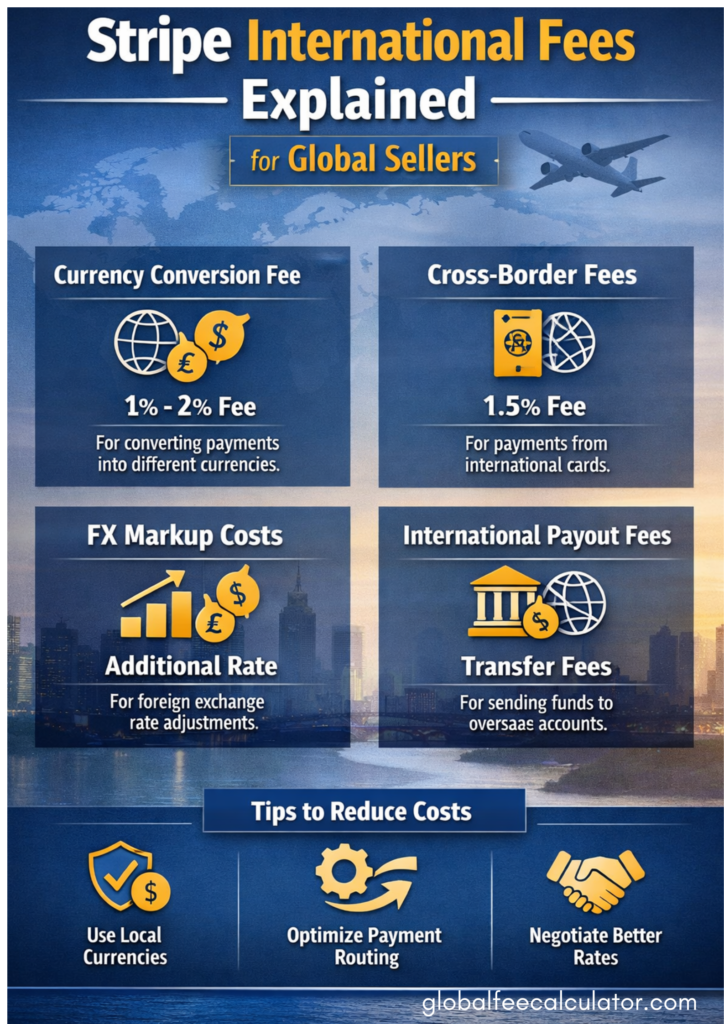
Currency Conversion Fees Explained
Currency conversion is one of the most misunderstood Stripe costs.
When Conversion Fees Apply
Stripe applies a currency conversion fee when:
-
You charge a customer in one currency
-
Your Stripe account settles in another currency
This often happens when sellers allow customers to pay in their local currency but receive payouts in a single base currency.
What the Conversion Fee Includes
The conversion cost typically consists of:
-
A percentage-based conversion fee
-
An exchange rate margin that fluctuates daily
These costs are embedded into the transaction, making them easy to miss unless you review detailed payout reports.
Regional Differences in Stripe International Fees
International fees vary depending on regions involved.
Card Issuer Location Matters
A payment is considered international if:
-
The customer’s card is issued outside your Stripe account’s country
Even if the customer lives locally but uses a foreign-issued card, international fees can still apply.
Payment Method Variations
Different regions prefer different payment methods, and each has its own fee structure. Some international payment methods:
-
Cost more than standard card payments
-
Have higher failure or refund rates
Accepting local payment methods improves conversion but can change overall fee averages.
Additional International Costs Sellers Overlook
Beyond transaction and conversion fees, global sellers may encounter other indirect costs.
Refunds on International Payments
When refunding international transactions:
-
Fixed processing fees are usually not returned
-
Currency conversion costs are not reversed
Frequent refunds from international customers increase effective fee rates.
Disputes and Chargebacks
International disputes often involve:
-
Higher chargeback risk
-
Flat dispute fees per case
Even a small number of disputes can significantly affect net revenue.
Payout Timing and Fees
In some regions:
-
International payouts take longer to settle
-
Faster payout options may involve additional charges
While not always labeled as “international fees,” these costs still affect cash flow
Because international Stripe fees vary by currency and payment method, using a tool to calculate Stripe fees accurately helps businesses estimate real costs before pricing products.
Practical, Legal Ways to Manage Stripe International Fees
International fees are unavoidable, but they can be managed intelligently.
Price for Global Averages
Instead of pricing based only on domestic fees:
-
Calculate average fees across domestic and international sales
-
Adjust pricing to reflect real blended costs
This prevents international orders from becoming less profitable.
Optimize Transaction Value
Fixed fees impact smaller orders more heavily. Global sellers can reduce this effect by:
-
Bundling products
-
Offering minimum order thresholds
-
Encouraging longer subscription cycles
Higher transaction values reduce the percentage impact of fixed fees.
Choose Settlement Currency Strategically
If most customers pay in one currency:
-
Consider settling in that same currency
-
Reduce unnecessary currency conversions
This approach simplifies accounting and lowers conversion-related costs.
Limit High-Risk Payment Scenarios
Clear policies help reduce international disputes:
-
Transparent shipping timelines
-
Clear refund and return rules
-
Accurate product descriptions
Lower dispute rates mean fewer fee losses.
Review Payment Method Performance
Not all international payment methods perform equally. Monitor:
-
Fee percentages by method
-
Refund and failure rates
Disabling underperforming methods can improve overall profitability without reducing conversions
To understand where international charges fit into the bigger picture, it helps to first see how Stripe fees work across all transaction types.

Common Mistakes Global Sellers Make
Treating All Sales the Same
International and domestic sales have different cost structures. Ignoring this leads to inaccurate margins.
Overlooking Conversion Costs
Many sellers assume exchange rates are “free” or negligible. Over time, conversion fees can become one of the largest international costs.
Absorbing Fees Without Tracking Them
Absorbing fees may improve customer experience, but without proper tracking, it can quietly erode profits.
Expanding Internationally Without Repricing
Launching global shipping or digital sales without reviewing pricing often results in undercharging international customer
Along with cross-border charges, businesses should also be aware of other hidden Stripe fees that can quietly reduce profit.
Recommended Tools to Reduce These Fees
Managing Stripe international fees is primarily about visibility and planning. Neutral tools designed for sellers can help:
-
Estimate total international transaction costs
-
Compare domestic vs cross-border payment fees
-
Factor in currency conversion and refund scenarios
Fee calculators allow businesses to test pricing strategies and understand real margins before committing to global expansion—without changing providers or violating Stripe policies.
Final Summary
Stripe makes global selling accessible, but international payments come with added complexity. Stripe international fees include more than just higher percentages—they involve currency conversion costs, fixed-fee impacts, and region-specific charges that many sellers overlook.
Key takeaways for global sellers:
-
International card and conversion fees are separate costs
-
Small transactions are disproportionately affected
-
Accurate calculations prevent underpricing
-
Legal, strategic planning improves global profitability
Selling globally works best when pricing decisions are based on full cost awareness, not assumptions. Informed sellers protect their margins while confidently expanding into international markets.
Frequently Asked Questions (FAQs)
1. What counts as an international payment on Stripe?
A payment is international if the customer’s card is issued in a different country than your Stripe account.
2. Does Stripe charge international fees even if customers pay in my currency?
Yes. International card fees can apply regardless of the transaction currency.
3. Are currency conversion fees optional?
No. Conversion fees apply whenever charge and settlement currencies differ.
4. Do international refunds return all Stripe fees?
No. Fixed processing fees and conversion costs are typically not refunded.
5. Are international fees higher for digital products?
The fee structure is the same, but digital sellers often feel the impact more due to smaller transaction sizes.
6. Can I avoid international fees by blocking foreign cards?
Technically yes, but it limits global growth and customer reach.
7. Do all payment methods have the same international fees?
No. Fees vary by payment method and region.
8. How often should I review international Stripe fees?
Regularly, especially when entering new markets or changing pricing.
9. Are Stripe international fees negotiable?
Typically no for small businesses, but high-volume sellers may have custom pricing.
10. Why do payouts sometimes seem lower than expected?
International card fees, currency conversion costs, refunds, and disputes often explain the difference.
Recommendation:
Always verify details directly on the official company website before making any business or financial decision.