
Choosing the right platform for your online business isn’t just about features—it’s about profitability. Etsy and Shopify are two of the most popular options for small businesses and creators, but they have very different fee structures. In 2026, understanding how Etsy vs Shopify fees compare is crucial for pricing products, managing margins, and deciding where to build your shop.
This article breaks down fee categories, compares real cost scenarios, and explains when each platform makes financial sense depending on your sales volume, pricing, and business model.
Table of Contents
ToggleHow Etsy and Shopify Approach Fees
At a high level:
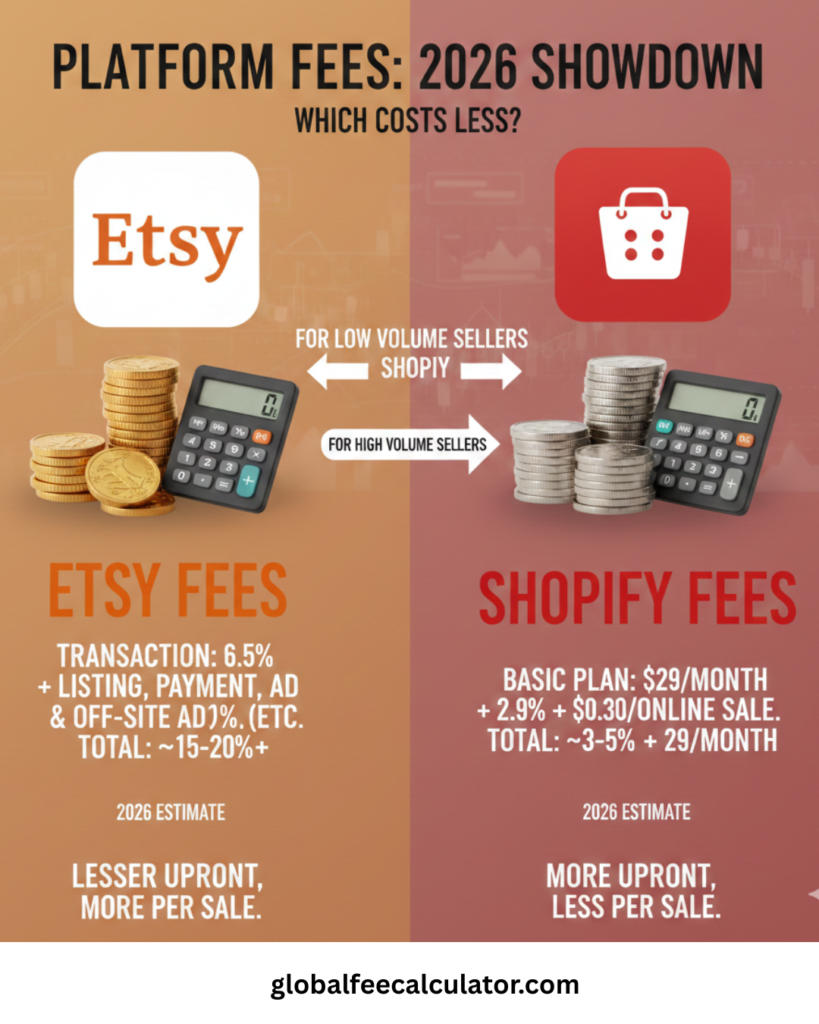
Etsy is a marketplace: no mandatory monthly fee (basic), but higher per-sale fees. You benefit from built-in traffic, but pay a percentage of each sale and multiple smaller fees.
Shopify is an eCommerce platform: you pay a monthly subscription plus payment/transaction fees, but there are no listing fees and per-sale costs are usually lower as you scale.
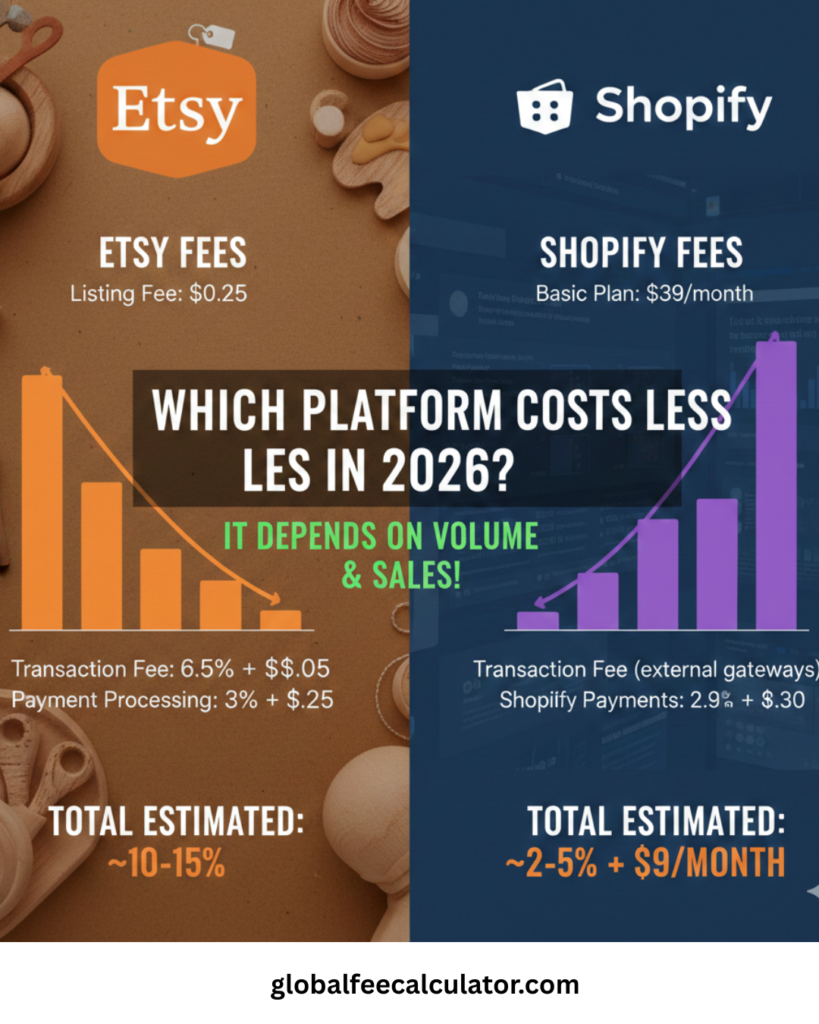
These differences mean that Etsy is often cheaper for very low-volume sellers, while Shopify becomes cheaper and more profitable as sales volume increases
Etsy Fee Structure Explained (USA Example)
Etsy charges several fees on each sale:
Listing Fee
A fixed fee per item listed (e.g., $0.20 USD).
Listings expire after four months or when sold, and each renewal incurs a new listing fee.
Transaction Fee
A percentage of the total order value (item price + shipping).
Typically around 6.5%.
Payment Processing Fee
Charged when Etsy handles the payment via Etsy Payments.
In the U.S., often around 3% + $0.25 per transaction.
Optional & Hidden Fees
Etsy Plus: ~ $10/month for extra tools.
Offsite Ads fees: Etsy may charge 12–15% if a sale comes from an ad.
Currency conversion or other regional charges depending on seller location.
Total Effect: Etsy’s base costs per sale often total 9% or more of the order value once all fees are counted—sometimes significantly higher when advertising and renewals are included.
Sellers who want a deeper understanding of Etsy’s fee structure should review how Etsy fees work across listings, transactions, and hidden costs.
Shopify Fee Structure Explained
Shopify’s fees work differently:
Monthly Subscription
Basic plans start around $29/month (paid annually may reduce the monthly equivalent).
Higher plans cost more but reduce some marginal fees and add features.
Payment Processing Fees
Using Shopify Payments (Shopify’s default processor):
Basic: ~2.9% + $0.30 per transaction
Higher plans may reduce the percentage slightly (e.g., 2.7%, 2.5%) depending on tier.
If you use a third-party payment gateway, Shopify may charge an additional small transaction fee (but using Shopify Payments typically avoids this).
No Listing Fees
Unlike Etsy, Shopify does not charge per-product listing fees. You can list unlimited products on any plan.
Optional Costs
Paid apps, themes, and integrations can add to cost
Domain name registration (~$10–$20/year)
Overall, Shopify’s costs are more predictable per sale, but you pay upfront subscription fees regardless of whether you make sales. Since Shopify relies heavily on payment processing costs, it’s useful to compare payment gateways with the lowest transaction fees before finalizing your setup.
Direct Fee Comparison: Etsy vs Shopify
Here’s how the platforms differ on common cost types:
| Fee Type | Etsy | Shopify |
|---|---|---|
| Monthly Subscription | $0 (free) or $10 Etsy Plus | ~$29+ / month |
| Listing Fee | ~$0.20 per listing | ❌ No listing fee |
| Transaction Fee | ~6.5% of order value | ❌ No Shopify transaction fee (if using Shopify Payments) |
| Payment Processing | ~3% + $0.25 | ~2.9% + $0.30 |
| Advertising Fees | Optional Etsy Ads / Offsite Ads | Optional third-party ads |
| Unlimited Products | ❌ Listing costs increase | ✔️ Unlimited listings at no extra cost |
For a personalized estimate based on your product price and order volume, use a fee calculator to model both Etsy and Shopify costs before deciding.
When Etsy Costs Less
Etsy’s fee structure can be more economical for:
Smaller Shops or Casual Sellers
If you sell few items per month, the lack of a mandatory subscription makes Etsy cheaper. For example:
5 x $30 products in a month: Etsy’s per-sale fees may be less than Shopify’s subscription plus processing.
Sellers Who Prefer Marketplace Traffic
Etsy brings built-in customers, reducing the need for external marketing. That convenience often compensates for higher fees for new sellers.
Low Volume or Irregular Sales Patterns
If you sell sporadically, Etsy’s pay-as-you-go approach means you don’t incur subscription costs when sales are slow. To fully understand Etsy’s structure, review how Etsy fees work across listings, transactions, and hidden costs.
When Shopify Costs Less
Shopify becomes more cost-effective as sales volume increases:
Consistent or High Volume Sales
Because Shopify doesn’t charge a transaction fee (on Shopify Payments) or listing fees, your effective cost per sale can be much lower as you sell more.
Unlimited Products Without Extra Listing Costs
Shopify lets you list as many products as you want for a flat subscription—ideal for stores with large catalogs.
Scaling and Growth
At scale, the subscription becomes a small overhead compared to savings from lower per-sale fees. Research suggests Shopify often becomes cheaper than Etsy as monthly sales grow beyond a certain point
Fee Example Scenarios (Simplified Approximation)
Scenario 1: Low Volume Seller
Etsy: No subscription + costs per listing and sale
Shopify: ~$29 monthly + processing fees
→ If sales are few, Etsy often costs less.
Scenario 2: Growing Shop (Volume > 30+ Orders/Month)
Etsy: Per-sale fees add up quickly
Shopify: Subscription amortized across many sales
→ Shopify tends to cost less per unit sold as volume increases.
Actual cost depends on pricing, product value, and sales consistency.
Other Cost Considerations Beyond Fees
When comparing Etsy vs Shopify, fees aren’t the only financial factors:
Customer Acquisition
Etsy’s marketplace brings some organic traffic
Shopify requires marketing investment (e.g., SEO, ads)
Branding and Control
Shopify gives full control over branding and customer experience
Etsy limits customisation and pushes marketplace branding
Scalability and Tools
Shopify’s platform supports apps, automations, and integrations that can increase sales (but also costs).
Example Cost Breakdown: $50 Product Comparison (USA Seller)
Let’s assume:
Product price: $50
Shipping: $5
40 orders per month
Etsy Approximate Cost Per Order
Listing fee: $0.20
Transaction fee (6.5% of $55): ~$3.58
Payment processing (~3% + $0.25): ~$1.90
Estimated total fee per order: ~$5.68
Effective fee rate: ~10%+
Monthly fee cost (40 orders): ~$227
Shopify Approximate Cost Per Order
Monthly plan: $29
Processing (2.9% + $0.30 on $55): ~$1.90
Estimated fee per order: ~$1.90
Monthly processing (40 orders): ~$76
Total monthly cost including subscription: ~$105
Effective cost rate decreases as volume increases.
This simplified example shows how Shopify’s flat subscription becomes more cost-efficient as order volume grows, while Etsy’s per-sale fees scale with revenue.
At What Sales Volume Does Shopify Become Cheaper?
There is no fixed number because it depends on price per product and processing method. However, many sellers find that once monthly revenue consistently exceeds a few thousand dollars, Shopify’s subscription cost becomes small relative to Etsy’s percentage-based fees.
In simple terms:
Low volume → Etsy often cheaper
Consistent volume → Shopify often cheaper
High volume → Shopify usually significantly cheaper
Running the numbers using a fee calculator is the safest way to determine your break-even point.
When Etsy May Not Be Ideal
Sellers with high margins who want brand ownership
Businesses planning large catalogs
Sellers frustrated by percentage-based fees
When Shopify May Not Be Ideal
Very low-volume or hobby sellers
Sellers unwilling to manage marketing and traffic
Businesses not ready for monthly subscription overhead
Sellers should calculate Etsy seller profit after fees before comparing net margins with Shopify.
Final Summary: Which Platform Costs Less?
There’s no one-size-fits-all answer—but:
Etsy is generally cheaper for:
New sellers testing products
Low monthly sales volume
Sellers seeking marketplace traffic without upfront cost
Shopify is generally cheaper for:
High-volume sellers
Larger catalogs with many products
Sellers focused on brand control and scalability
Sellers who drive their own traffic
The right choice depends on your business stage, sales volume, and long-term goals.
Many Shopify stores use Stripe-backed processing, so understanding Stripe pricing models for businesses can help estimate real costs.
Frequently Asked Questions (FAQs)
1. Does Etsy charge a monthly fee?
No, unless you opt into Etsy Plus, which is optional.
2. Does Shopify charge transaction fees?
If you use Shopify Payments, Shopify does not charge its own transaction fee. Otherwise, a small fee can apply.
3. Do listing fees apply on Shopify?
No. Shopify does not charge per-product listing fees.
4. Are Etsy’s fees higher than Shopify’s per sale?
In percentage terms, Etsy’s combined fees are typically higher than Shopify’s payment processing fees.
5. Which platform suits beginners best?
Etsy suits beginners with low upfront cost; Shopify suits sellers ready to invest in their own store and traffic.
6. Does Etsy include advertising fees?
Yes; optional or mandatory offsite ad fees can apply and significantly increase total cost.
7. How often should I review fee impact?
Regularly; especially before scaling or changing your product mix.