

Selling on Etsy gives small businesses access to a massive marketplace, but understanding the platform’s fee structure is essential if you want to stay profitable. Many U.S. sellers focus on sales volume and visibility while underestimating how Etsy fees quietly reduce margins over time.
Etsy fees are not charged in one place or in one simple percentage. They are layered, applied at different stages, and influenced by how you price, ship, and promote your products. Sellers who don’t fully understand these costs often price too low, misread payouts, or assume a product is profitable when it isn’t.
Want to calculate your real profit after Etsy fees? Use our Etsy Fee Calculator USA to estimate your exact take-home earnings per sale before listing your products.
This guide explains Etsy fees in the USA clearly and practically. You’ll learn what fees apply, how they’re calculated, where sellers make mistakes, and why accurate fee calculation matters before you list or scale products.
Table of Contents
ToggleWhy Understanding Etsy Fees Matters for U.S. Sellers
Etsy fees directly impact:
Your pricing strategy
Your profit margins
Your ability to run discounts or ads
Your long-term business sustainability
Even small fees can add up quickly, especially for high-volume sellers or low-priced items. Without a clear understanding of Etsy’s fee structure, sellers often confuse revenue with profit—and that confusion can cost real money.
Overview of Etsy’s Fee System in the USA
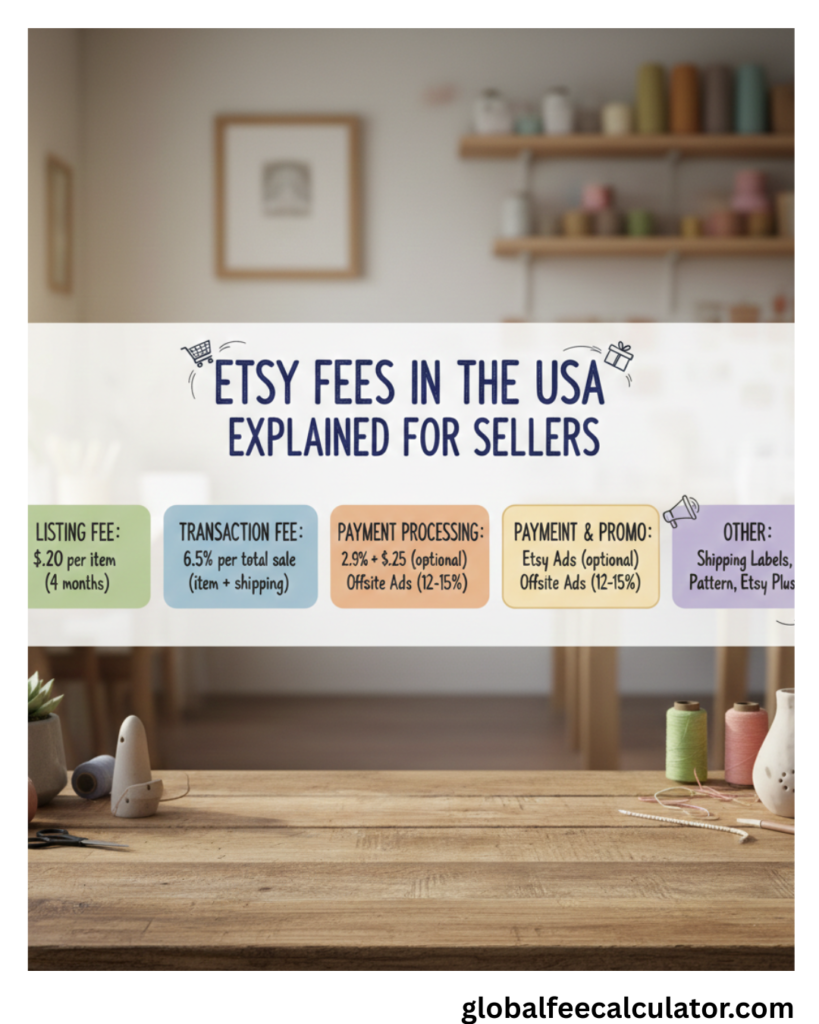
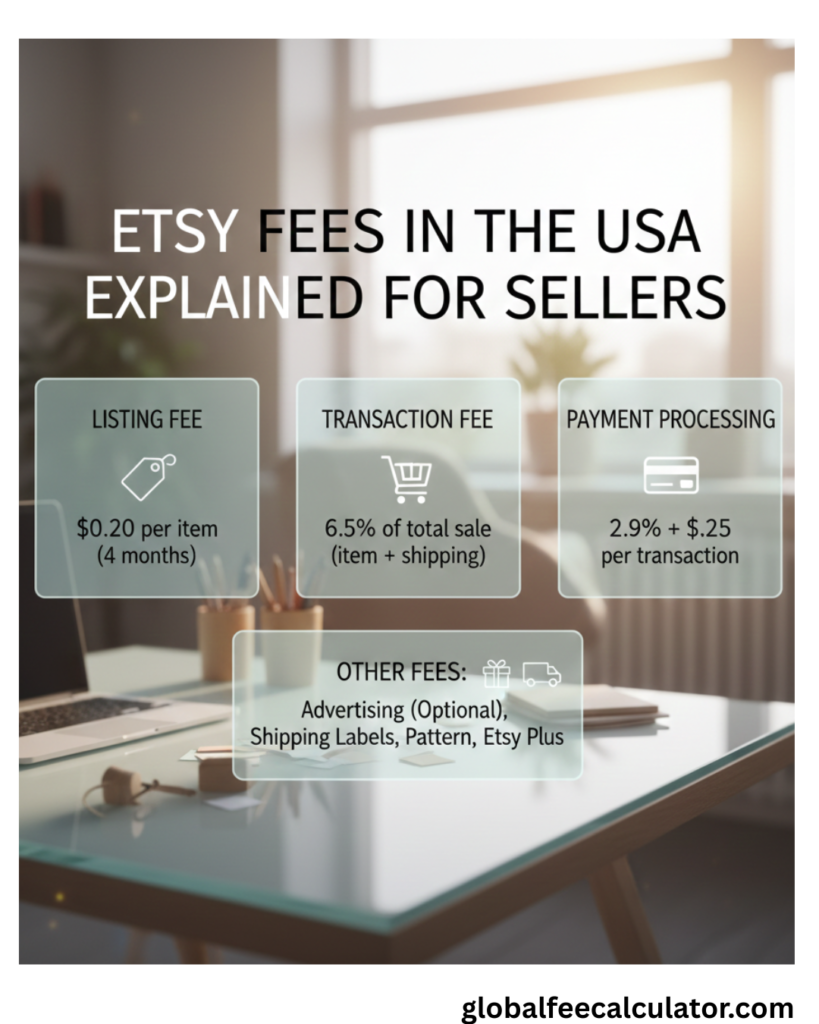
Etsy charges sellers for using its marketplace, payment infrastructure, and advertising services. In the U.S., fees generally fall into these categories:
Listing fees
Transaction fees
Payment processing fees
Advertising-related fees
Optional service fees
Each fee serves a different purpose and is applied differently.
For a complete global breakdown of Etsy’s fee structure across countries, see our detailed guide on Complete Etsy Fees Explained.
Listing Fees
Every product you list on Etsy comes with a listing fee.
Key points:
Charged per listing
Applies whether the item sells or not
Renews automatically if the product sells or expires
This fee may seem small, but for sellers with many low-selling listings, it adds up over time. Relisting unsold inventory without reviewing profitability is a common mistake.
Transaction Fees
Etsy charges a transaction fee when an item sells.
Important details:
Calculated as a percentage of the item price
Applies to add-ons, personalization, or upgrades
Charged on the total item amount (not profit)
If you increase prices without accounting for this percentage-based fee, Etsy’s share grows along with your revenue.
Payment Processing Fees (Etsy Payments – USA)
U.S. sellers are required to use Etsy Payments, which comes with its own processing fees.
These fees include:
A percentage of the order total
A fixed fee per transaction
Payment processing fees apply to:
Item price
Shipping charged to the buyer
Sales tax collected (where applicable)
This means Etsy’s payment fee is often higher than sellers expect, especially on orders with high shipping costs.
If you’re comparing payment costs, read our detailed comparison of Stripe vs PayPal vs Square Fees to understand how Etsy Payments compares to standalone processors.
Sales Tax Handling in the USA
In the United States, Etsy acts as a marketplace facilitator in many states.
What this means:
Etsy collects and remits sales tax on behalf of sellers in applicable states
Sellers usually don’t receive this tax as part of their payout
Payment processing fees may still apply to the collected tax
Even though Etsy handles tax remittance, sellers should still understand how taxes affect gross order totals and processing fees.
Offsite Ads Fees
Etsy runs offsite advertising on platforms like search engines and social media. If one of these ads leads to a sale, an offsite ads fee applies.
Key points:
Only charged when an ad results in a sale
Calculated as a percentage of the order total
Applied automatically for eligible sellers
For some sellers, offsite ads bring valuable traffic. For others, they significantly reduce margins—especially on already low-profit items.
Costs Etsy Does Not Include in Fee Reports
Etsy’s dashboard shows fees—but not your real business expenses.
U.S. sellers must separately account for:
Materials or product manufacturing
Packaging supplies
Shipping supplies
Labor or fulfillment time
Design tools, subscriptions, or software
Marketing outside Etsy
Ignoring these costs creates a false sense of profitability
Common Fee-Related Mistakes U.S. Etsy Sellers Make
Confusing Revenue With Profit
A high sales month doesn’t guarantee high profit once all fees and costs are deducted.
Pricing Based on Competitors
Matching competitor prices without understanding their cost structure often leads to underpricing.
Ignoring Offsite Ads Impact
Sellers may not realize offsite ads are reducing margins until reviewing detailed statements.
Forgetting Listing Fees Over Time
Slow-moving listings accumulate costs month after month.
You can avoid this by following our step-by-step guide on How to Calculate Etsy Seller Profit After Fees.
Recommended Tools to Reduce These Fees
Fee Calculators
Help estimate Etsy fees and net profit before listing or adjusting prices.
Cost Tracking Spreadsheets
Allow sellers to track materials, packaging, and shipping costs accurately.
Pricing Review Checklists
Useful for reviewing older listings that may no longer be profitable due to rising costs.
These tools don’t remove Etsy fees—but they help sellers avoid costly pricing mistakes.
Final Summary
Understanding Etsy fees in the USA is essential for running a profitable shop. Etsy’s fee structure includes listing fees, transaction fees, payment processing fees, advertising fees, and indirect costs that many sellers overlook.
By learning how each fee works, tracking real business expenses, and calculating profit accurately, U.S. sellers can price products with confidence, protect margins, and make informed decisions instead of guessing.
Profitability on Etsy isn’t about selling more—it’s about selling smarter
Frequently Asked Questions (FAQs)
1. Are Etsy fees the same for all U.S. sellers?
Yes, the core fee structure is the same, though taxes and optional services may vary.
2. Does Etsy charge fees on shipping?
Payment processing fees apply to shipping charged to buyers.
3. Are listing fees refundable?
No. Listing fees apply even if an item does not sell.
4. Do offsite ads fees apply to every sale?
No. Only when a sale comes directly from an offsite ad.
5. Does Etsy take fees from sales tax?
Etsy collects and remits sales tax, but processing fees may still apply.
6. Why is my payout lower than expected?
Multiple fees are deducted at different stages, reducing net payout.
7. Are Etsy fees tax-deductible?
In many cases, Etsy fees can be treated as business expenses.
8. How often should I review my Etsy pricing?
At least quarterly, or whenever fees or costs change.
9. Can I run a profitable Etsy shop with low-priced items?
Yes, but only with careful fee calculation and cost control.
Recommendation:
Always verify details directly on the official company website before making any business or financial decision.