
Etsy is a popular marketplace for handmade, vintage, and creative products but for many sellers, understanding Etsy fees can feel confusing and overwhelming. Listing fees, transaction fees, payment processing charges, advertising costs, and other small deductions often stack together, reducing profit more than expected.
Many sellers focus on sales volume and customer demand, only to realize later that their margins are shrinking. The reason is rarely one single fee. Instead, it’s the combined effect of multiple Etsy fees, including some costs sellers don’t actively track.
This guide explains Etsy fees in detail from listing and transaction fees to payment processing and lesser-known hidden costs so you can calculate real profit accurately and make informed pricing decisions
Table of Contents
ToggleWhy Understanding Etsy Fees Is Crucial for Sellers
Etsy fees are predictable, but only if you understand how they work together. Sellers who ignore the full fee structure often:
Underprice products
Misjudge profitability
Struggle to scale sustainably
Feel surprised by low payouts
Even small fees matter when you sell regularly or operate on thin margins. Knowing exactly what Etsy charges allows you to price confidently, forecast earnings, and avoid slow profit loss.
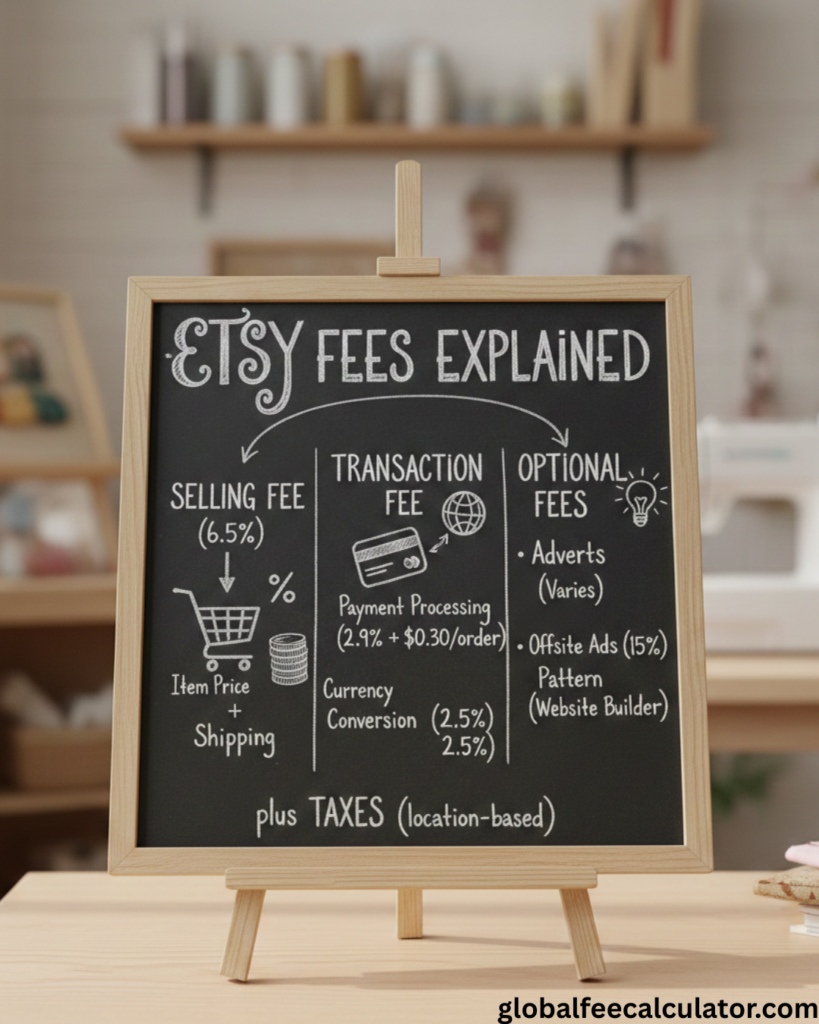
Overview of Etsy’s Fee Structure
Etsy charges fees at different stages of a sale. Some apply whether an item sells or not, while others apply only after a transaction is completed.
The main categories include:
Listing fees
Transaction fees
Payment processing fees
Advertising and promotion fees
Currency conversion and international costs
Let’s break each one down clearly
1. Etsy Listing Fees Explained
A listing fee is charged every time you publish a product on Etsy.
How listing fees work
Each listing incurs a fixed fee
Listings remain active for a limited period or until sold
Fees apply to renewals and multiple quantities
Important details sellers often miss
If you list multiple quantities, the fee may apply again when an item sells
Relisting manually or automatically triggers another listing fee
Slow-moving products can accumulate listing costs over time
Why listing fees matter
Listing fees may seem small individually, but they add up quickly for sellers with:
Large inventories
Frequent renewals
Seasonal or slow-selling items
Managing listings strategically is key to controlling these costs.
Since multiple Etsy fees apply to every order, using a tool to calculate Etsy fees accurately helps sellers avoid underpricing.
2. Etsy Transaction Fees Explained
Transaction fees are charged when a sale is completed.
What the transaction fee applies to
Item price
Shipping cost (in many cases)
Gift wrapping or add-ons
This fee is calculated as a percentage of the total order value.
Why transaction fees affect margins
Transaction fees scale with your price. Higher-priced items pay more in absolute fees, while lower-priced items feel the impact more strongly as a percentage of profit.
Sellers who don’t account for transaction fees often find their net earnings are lower than expected.
Understanding Etsy fees is only the first step—sellers should also learn how to calculate Etsy seller profit after fees to see their real earnings per order.
3. Etsy Payment Processing Fees
Payment processing fees apply when Etsy processes a customer’s payment on your behalf.
What these fees cover
Card payments
Digital wallets
Local payment methods
Payment processing fees typically include:
A percentage of the order total
A fixed per-transaction amount
Why payment fees feel “hidden”
Unlike listing fees, payment processing fees:
Are deducted automatically
Appear only in payout breakdowns
Are easy to overlook during pricing
For sellers with many small orders, fixed payment fees can significantly reduce margins.
4. Advertising and Promotion Fees
Etsy offers promotional tools that can increase visibility—but they also add costs.
Etsy Ads
Sellers set a daily budget
Fees are charged when ads generate clicks
Costs vary based on competition and demand
Offsite Ads
Etsy promotes products on external platforms
Fees apply when a sale comes from an offsite ad
Referral fees are deducted from the sale
Why ad fees need careful tracking
Advertising can boost sales, but if fees aren’t factored into pricing, sellers may gain traffic while losing profit.
Ad performance should always be evaluated based on net profit after fees, not just revenue
5. Currency Conversion and International Fees
International selling introduces additional costs that many sellers overlook.
How currency conversion fees occur
When your shop currency differs from the buyer’s currency
When Etsy converts funds before payout
Why this matters
Currency conversion fees reduce the amount you receive, even if your product price stays the same.
For sellers with a global audience, these fees can quietly eat into margins—especially on recurring international sales.
6. Etsy Payment Processing Fees by Country (Often Overlooked)
Etsy payment processing fees are not the same worldwide. While the fee structure follows a similar pattern, the exact percentage and fixed fee vary depending on the seller’s country and local payment regulations.
Why this matters for sellers
Two sellers listing the same product at the same price may receive different payouts simply because they operate in different countries. This difference becomes more noticeable when selling high volumes or low-priced products.
Common regional variations sellers experience
Higher fixed fees in some regions
Different percentage rates based on local banking costs
Additional charges for cross-border payments
Sellers operating internationally or planning to scale globally should always factor regional payment fees into pricing instead of relying on generalized averages.
Sellers operating globally should review Etsy seller fees by country, as fee structures and payment processing costs vary by region.
7. How Etsy Fees Compound Over Time
One of the biggest misconceptions among sellers is viewing Etsy fees as isolated charges. In reality, Etsy fees compound over time, especially for active shops.
How compounding happens
Listings renew every few months
Transaction fees apply to every sale
Payment processing fees apply to every payout
Advertising fees repeat with every ad-driven sale
Even when individual fees look small, the cumulative effect over hundreds or thousands of orders can significantly reduce annual profit.
Why long-term sellers feel the impact more
Shops with steady sales volume often feel more pressure from fees than new sellers because compounding works silently. Without periodic review, sellers may not notice profit erosion until margins are already thin.
8. Etsy Fees vs Profit Margins (Why Sales Alone Don’t Matter)
High sales volume does not always equal high profit on Etsy. Fees directly influence profit margins, not just total revenue.
A common mistake sellers make
Many sellers price products based on competitors or perceived demand without reverse-calculating fees. This often leads to strong sales but weak payouts.
What sellers should focus on instead
Net payout per order
Profit per product after all fees
Impact of refunds and advertising
Understanding Etsy fees allows sellers to evaluate success based on real earnings rather than vanity metrics like order count or gross revenue.
9. When Etsy Fees Hurt the Most
Etsy fees have the strongest impact in specific situations.
Low-priced products
Fixed fees take up a much larger percentage of revenue on low-ticket items, making profitability harder without bundling or upsells.
International-heavy sales
Currency conversion and cross-border payment fees quietly reduce payouts, especially for global sellers.
Frequent promotions or ads
Advertising fees can outpace profit if campaigns are not monitored closely.
Shops with frequent refunds
Non-refundable fees can turn refunded orders into direct losses.
Recognizing these scenarios helps sellers adjust pricing and strategy proactively.
10. How Successful Sellers Plan for Etsy Fees
Profitable Etsy sellers do not eliminate fees—they plan around them.
What experienced sellers do differently
Build fees into pricing from day one
Use bundles to increase average order value
Limit unnecessary listing renewals
Monitor payout reports instead of just sales dashboards
Review fees monthly instead of yearly
This approach transforms fees from a surprise into a predictable business expense.

11. Refund-Related Costs Sellers Often Miss
Refunds don’t always restore all fees.
What usually happens with refunds
Listing fees are typically not refunded
Payment processing fees may not be returned
Advertising fees are often non-refundable
Why this impacts pricing
If your shop experiences:
Frequent refunds
Free trials or guarantees
High return rates
You must price products knowing that some fees are unrecoverable
Sellers who want a deeper numerical breakdown can also explore Etsy fee calculations explained step by step.
Common “Hidden” Etsy Costs Sellers Ignore
These costs aren’t hidden by Etsy—but they’re often ignored:
Multiple listing renewals
Fees on shipping charges
Currency conversion deductions
Advertising fees blended into payouts
Lost fees on refunds
Individually, they seem small. Together, they shape real profitability.
Recommended Tools to Reduce These Costs
Neutral fee-calculation tools can help Etsy sellers:
Estimate total fees per product
Compare pricing scenarios
Analyze domestic vs international orders
Model ad and shipping impacts
Calculate net profit accurately
These tools don’t change Etsy’s fees—but they eliminate guesswork, which is often the biggest source of loss.
Once all fees are understood, sellers can apply practical strategies to reduce Etsy fees legally.
Practical Tips for Managing Etsy Fees Better
While you can’t remove Etsy fees, you can manage them effectively:
Price products to absorb all fees
Increase average order value through bundles
Limit unnecessary listing renewals
Monitor ad performance closely
Review payout reports regularly
Small adjustments make a meaningful difference over time.
Why Etsy Fee Awareness Matters More Than Ever in 2026
Etsy continues to evolve its platform, payment systems, and advertising tools. As features expand, so do fee touchpoints. Sellers who rely on outdated assumptions often misjudge real costs.
In 2026, successful Etsy selling is less about listing more products and more about understanding how platform fees interact with pricing, demand, and volume. Sellers who treat Etsy like a business—rather than a side project—are the ones who sustain profit long term.
Final Summary
Etsy fees include more than just a listing or transaction charge. Listing fees, transaction fees, payment processing costs, advertising fees, currency conversion, and refund-related losses all combine to shape your real profit.
Successful Etsy sellers don’t avoid fees—they understand, calculate, and plan for them. When you price products with full fee awareness and track payouts instead of just sales, you gain control over your margins and long-term sustainability.
Profit on Etsy isn’t about selling more—it’s about selling smarter.
Frequently Asked Questions (FAQs)
1. What are the main Etsy fees sellers pay?
Listing fees, transaction fees, payment processing fees, advertising fees, and currency conversion costs.
2. Do Etsy fees apply to shipping?
In many cases, transaction fees apply to the total order value, including shipping.
3. Are Etsy listing fees refundable?
No. Listing fees generally apply whether or not an item sells.
4. Do refunds return all Etsy fees?
Usually not. Some fees, such as listing and payment processing fees, may not be refunded.
5. Are international Etsy sales more expensive?
Yes. Currency conversion and international payment costs can reduce net payouts.
6. Why do Etsy fees feel higher on low-priced items?
Fixed fees take up a larger percentage of revenue on low-priced products.
7. Should sellers include fees in pricing?
Yes. Pricing without accounting for fees often leads to underpricing.
8. How often should Etsy sellers review fee reports?
Regularly—monthly or quarterly—to catch issues early.
9. Can fee calculators help Etsy sellers?
Yes. They help estimate real profit before listing or running promotions.
Recommendation:
Always verify details directly on the official company website before making any business or financial decision.