

Stripe is often seen as a reliable, transparent payment processor. For many online businesses, it becomes the default choice because setup is simple and payments “just work.” Yet, a large number of sellers quietly lose money every month—not because Stripe is unfair, but because they misunderstand how Stripe fees affect real profit.
The issue isn’t usually one big fee. It’s the accumulation of small, overlooked costs that slowly erode margins. Businesses lose profit due to Stripe fees when they:
-
Price products based only on headline rates
-
Ignore fixed fees on small transactions
-
Overlook international, refund, and conversion costs
-
Scale without recalculating net margins
This article explains how businesses lose profit due to Stripe fees, where the losses happen, and how better awareness and calculation can prevent them—without breaking rules or changing payment providers.
To understand why these losses occur, it helps to first review how Stripe fees work across different transaction types and regions.
Table of Contents
ToggleUnderstanding Stripe Fees at a Profit Level
Stripe fees are charged per transaction, but profit loss happens at the business model level.
Most sellers focus on revenue:
-
“I sold $10,000 this month.”
But profit depends on:
-
What’s left after fees, refunds, disputes, and conversions.
Stripe fees directly reduce gross margin, and when margins are thin, even small fee miscalculations matter.
1. Underpricing Products by Ignoring Full Stripe Fees
One of the most common ways businesses lose profit is by pricing products using incomplete fee assumptions.
What Usually Happens
Many sellers price products assuming:
-
Only the base percentage fee
-
No refunds
-
Mostly domestic customers
But real-world sales include:
-
Fixed per-transaction fees
-
International card fees
-
Currency conversion costs
Result
Products appear profitable on paper but deliver lower-than-expected net revenue. Over time, this leads to:
-
Shrinking margins
-
Difficulty scaling
-
Confusion when payouts seem “too low”

2. Fixed Fees Destroy Margins on Small Transactions
Stripe charges a fixed fee on every transaction. This fee is the same whether you sell a $5 product or a $500 product.
Example
-
$5 sale
-
Fixed fee: $0.30
-
Percentage fee: ~$0.15
-
Total fee: ~$0.45
That’s nearly 9% lost to fees.
Where Businesses Lose Profit
-
Digital downloads
-
Low-priced Etsy products
-
Microtransactions
Sellers often don’t realize that low prices increase the effective fee rate dramatically.
3. International Sales Without Adjusted Pricing
Selling globally increases reach—but also increases Stripe fees.
Hidden Cost Areas
-
International card fees
-
Currency conversion fees
-
Higher refund or dispute rates
Common Mistake
Businesses offer the same price globally without accounting for these extra costs.
Result
International orders generate:
-
Lower profit than domestic ones
-
Sometimes even losses on discounted or low-margin items
This is a major reason businesses feel that “international sales don’t seem worth it.”
4. Currency Conversion Fees That Go Unnoticed
Currency conversion is one of the most invisible profit leaks.
Why It’s Overlooked
-
Conversion fees are embedded in exchange rates
-
They don’t always appear as a separate charge
How Profit Is Lost
Every time Stripe converts currency:
-
A percentage fee applies
-
Exchange rate margins fluctuate
For businesses with high international volume, this becomes a recurring margin drain that’s easy to underestimate.
Because small fees add up quickly, using a tool to calculate Stripe fees accurately helps businesses see real profit instead of relying on rough estimates.
5. Refunds That Permanently Remove Fees
Refunds don’t just reverse revenue—they often lock in losses.
What Many Sellers Don’t Realize
When a refund is issued:
The customer gets their full amount back
Stripe usually keeps the fixed transaction fee
Conversion fees are not returned
Profit Impact
Frequent refunds cause:
Higher effective Stripe fees
Lower net profit even with stable sales volume
Businesses with unclear product descriptions or loose refund policies feel this loss the most.
Because small fees add up quickly, using a tool to calculate Stripe fees accurately helps businesses see real profit instead of relying on rough estimates.
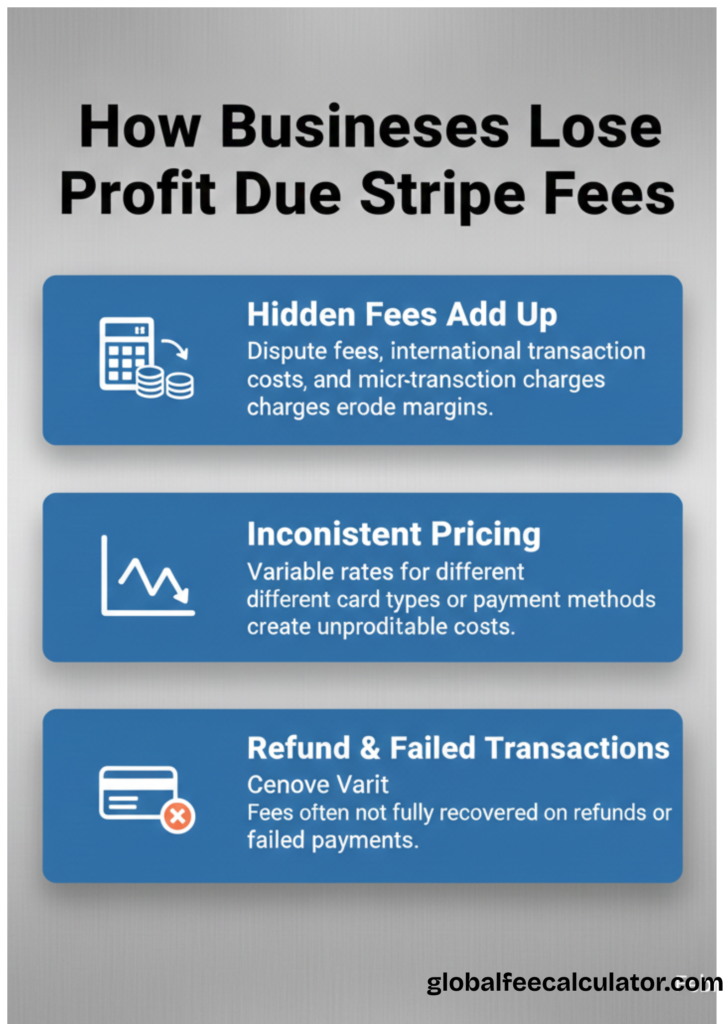
6. Chargebacks and Disputes Multiply Losses
Disputes are one of the most expensive Stripe-related issues.
Costs Involved
-
Flat dispute fee per case
-
Lost transaction amount if dispute is lost
-
Original processing fees already paid
Indirect Profit Loss
Even winning disputes costs time, staff effort, and operational focus—resources that could be spent growing the business.
Looking at Stripe fee structure with examples makes it easier to see how individual charges reduce margins over time.
7. Subscriptions That Leak Profit Over Time
For SaaS and membership businesses, Stripe fees compound monthly.
The Overlooked Problem
-
Each recurring charge has a fixed fee
-
Failed payments may trigger retries
-
Monthly billing increases transaction count
Example
A $15 monthly subscription may look profitable, but after:
-
Stripe fees
-
Failed payment retries
-
Customer churn
The net revenue per subscriber is often much lower than expected.
In some cases, switching to payment gateways with lower effective fees can significantly improve margins.
Why Accurate Fee Calculation Protects Profit
Stripe fees are predictable—but only when calculated correctly.
Accurate calculation allows businesses to:
-
Understand true profit per sale
-
Price products sustainably
-
Compare domestic vs international margins
-
Decide which products and markets make sense
Using a dedicated fee calculator helps sellers see real net revenue before listing products, launching discounts, or expanding globally—instead of discovering losses after payouts arrive.
Recommended Tools to Reduce These Losses
Profit loss from Stripe fees is rarely about the processor—it’s about visibility.
Neutral, calculation-focused tools can help businesses:
-
Break down Stripe fees per transaction
-
Model international and currency conversion costs
-
Test pricing, discount, and refund scenarios
Fee calculators give sellers a clearer picture of actual margins, helping prevent underpricing and silent profit leaks.
Once these profit leaks are identified, businesses can apply proven methods to reduce Stripe fees without switching payment providers.
Final Summary
Businesses don’t usually lose profit due to Stripe fees because Stripe is expensive—they lose profit because fees are misunderstood, underestimated, or ignored.
Key reasons profit is lost:
Incomplete fee assumptions during pricing
Fixed fees on small transactions
International and currency conversion costs
Refunds and disputes that lock in losses
Scaling without recalculating margins
Stripe fees are manageable when understood. Businesses that calculate accurately, price intentionally, and review fees regularly protect their margins and grow with confidence.
Many of these profit losses stem from avoidable pricing decisions. For a breakdown of the most common errors, see: Common Stripe Pricing Mistakes Businesses Make.
Frequently Asked Questions (FAQs)
1. Do Stripe fees directly reduce profit?
Yes. Stripe fees are deducted from revenue and directly impact margins.
2. Why do payouts seem lower than expected?
International fees, conversion costs, refunds, and disputes are common reasons.
3. Are small transactions less profitable on Stripe?
Often yes, due to the fixed per-transaction fee.
4. Do refunds permanently cost money?
Usually yes. Fixed fees and conversion costs are not returned.
5. Are international sales always less profitable?
Not always, but they require adjusted pricing to remain profitable.
6. Can Stripe fees be reduced legally?
Their impact can be reduced through pricing, bundling, and fee-aware strategies.
7. Do subscriptions lose more profit to fees?
They accumulate fees over time, especially with monthly billing.
8. How often should businesses review Stripe fees?
Regularly, especially after pricing changes or expansion.
9. Is guessing Stripe fees risky?
Yes. Small miscalculations compound over time.
10. What’s the safest way to protect profit from Stripe fees?
Accurate fee calculation, transparent pricing, and regular margin review
Recommendation:
Always verify details directly on the official company website before making any business or financial decision.