
Stripe is one of the most widely used payment platforms for online businesses, SaaS companies, and digital sellers. Its flexibility and global reach make it attractive—but its pricing is often misunderstood. Many business owners assume Stripe uses a single flat fee, only to discover later that Stripe pricing models vary depending on how you sell, where your customers are, and what payment methods you use.
This misunderstanding leads to common issues such as:
Underestimating real payment costs
Pricing products without accounting for all fees
Confusion when payouts don’t match expectations
This article explains Stripe pricing models in a clear, business-focused way, with practical examples and no marketing fluff. You’ll learn how Stripe charges fees, how different pricing models apply to different business types, and how to calculate costs accurately before scaling.
Before comparing pricing models, it’s useful to understand how Stripe fees work at a high level across transactions and regions.
Table of Contents
ToggleOverview of Stripe’s Pricing Approach
Stripe does not use a one-size-fits-all pricing model. Instead, it applies usage-based pricing with multiple components layered together.
At a high level, Stripe pricing depends on:
-
Transaction type (one-time vs recurring)
-
Customer location
-
Payment method
-
Currency and settlement preferences
Understanding these layers helps businesses choose the right pricing strategy and avoid margin erosion.
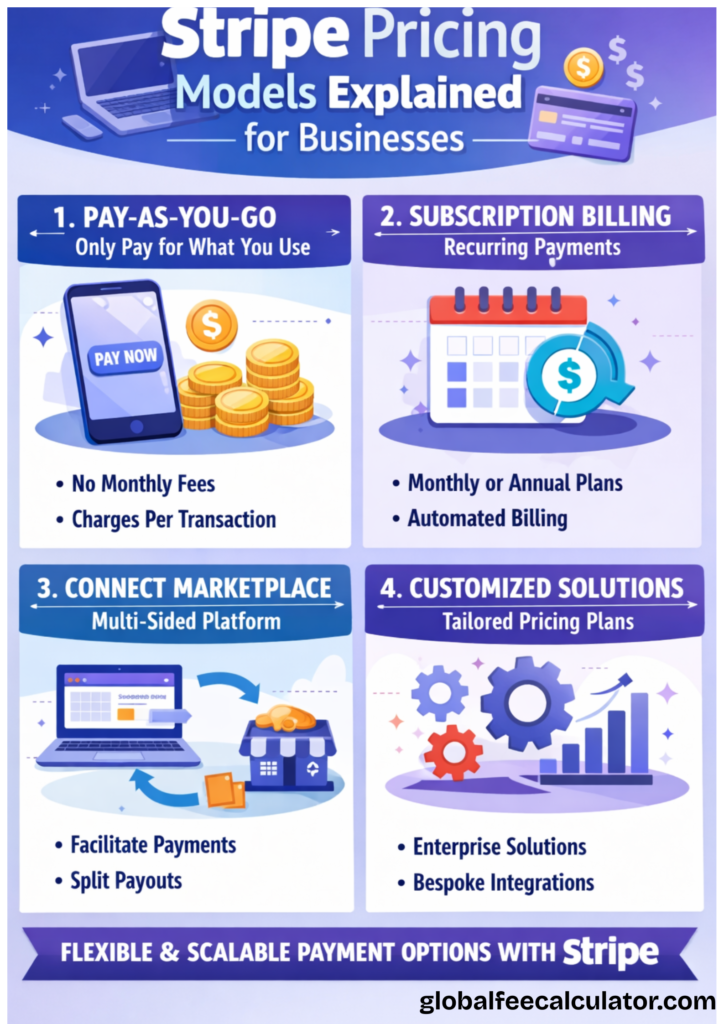
Standard Pay-As-You-Go Pricing Model
This is the most common Stripe pricing model and the default for most businesses.
How It Works
Stripe charges:
-
A percentage of each successful transaction
-
A fixed fee per transaction
This model applies to:
-
One-time product sales
-
Digital downloads
-
Services and invoices
Example
-
Sale price: $100
-
Percentage fee: 2.9%
-
Fixed fee: $0.30
-
Total Stripe fee: $3.20
-
Net received: $96.80
This model is simple, but it becomes more complex once international payments, refunds, or subscriptions are added.
Pricing Model for International Payments
Stripe applies additional pricing layers for global transactions.
International Card Pricing
When a customer’s card is issued outside your business’s country, Stripe adds:
-
An international card fee on top of the standard rate
This applies even if the customer pays in your local currency.
Currency Conversion Pricing
If the payment currency differs from your settlement currency:
-
Stripe applies a conversion fee
-
Exchange rate margins are included
For global sellers, this pricing model means international transactions almost always cost more than domestic ones.
Subscription and Recurring Billing Pricing Model
Stripe’s pricing for subscriptions follows the same transaction-based structure but applies repeatedly over time.
How Subscription Pricing Works
Each recurring charge includes:
-
Percentage-based processing fee
-
Fixed transaction fee
Example
-
Monthly subscription: $25
-
Stripe fee per charge: ~$1.03
-
Annual Stripe fees per subscriber: ~$12.36
Over hundreds or thousands of subscribers, these recurring fees significantly impact revenue.
Because pricing models affect total cost differently, using a tool to calculate Stripe fees accurately helps businesses compare real expenses before choosing a model.
Pricing Model for Small Transactions
Stripe’s fixed fee creates a de facto pricing model that disproportionately affects low-priced products.
Why Small Transactions Cost More
The fixed fee does not scale down with price.
Example:
-
Sale: $4
-
Fixed fee: $0.30
-
Effective fee percentage: 7.5% (before percentage fee)
This pricing reality affects:
-
Microtransactions
-
Digital downloads
-
Low-priced marketplace items
Businesses using this model often need to bundle products or set minimum prices.
For businesses evaluating alternatives, it’s helpful to compare low-fee payment gateway options available in 2026.
Payment Method–Based Pricing Models
Stripe supports many payment methods, each with its own pricing structure.
Card Payments
-
Most common
-
Predictable fees
-
Widely supported
Alternative and Local Payment Methods
Some methods:
-
Have higher processing fees
-
Carry higher failure or refund rates
-
Are preferred in specific regions
Stripe’s pricing model varies by payment method, so offering more options doesn’t always mean lower costs.
Custom Pricing Models for High-Volume Businesses
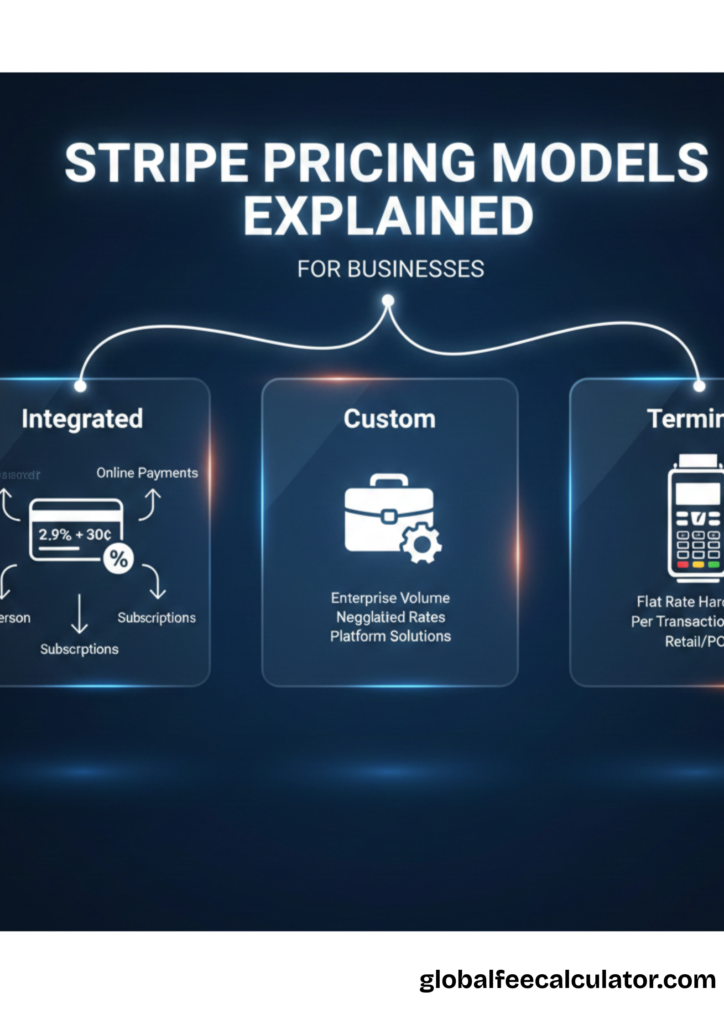
Stripe may offer custom pricing to businesses processing very high volumes.
What Custom Pricing Involves
-
Lower percentage fees
-
Different fixed fee structures
-
Volume-based agreements
This model is generally available only to large or rapidly scaling businesses.
For a clearer view of how these pricing models translate into actual charges, reviewing Stripe fee structure with examples can be helpful.
Common Pricing Mistakes Businesses Make
Assuming One Stripe Fee Covers Everything
Stripe pricing is layered, not flat.
Ignoring Fixed Fees in Discounts
Discounts reduce revenue but fixed fees remain unchanged.
Expanding Globally Without Repricing
International sales require different margin planning.
Guessing Fees Instead of Calculating Them
Estimations miss conversion, refund, and dispute costs.
Recommended Tools to Reduce These Fees
Managing Stripe pricing effectively requires visibility across all transaction types.
Neutral tools designed for businesses help:
-
Calculate Stripe fees across different pricing models
-
Compare domestic vs international transaction costs
-
Model subscriptions, refunds, and pricing scenarios
Fee calculators help businesses plan pricing decisions based on real costs rather than assumptions.
Final Summary
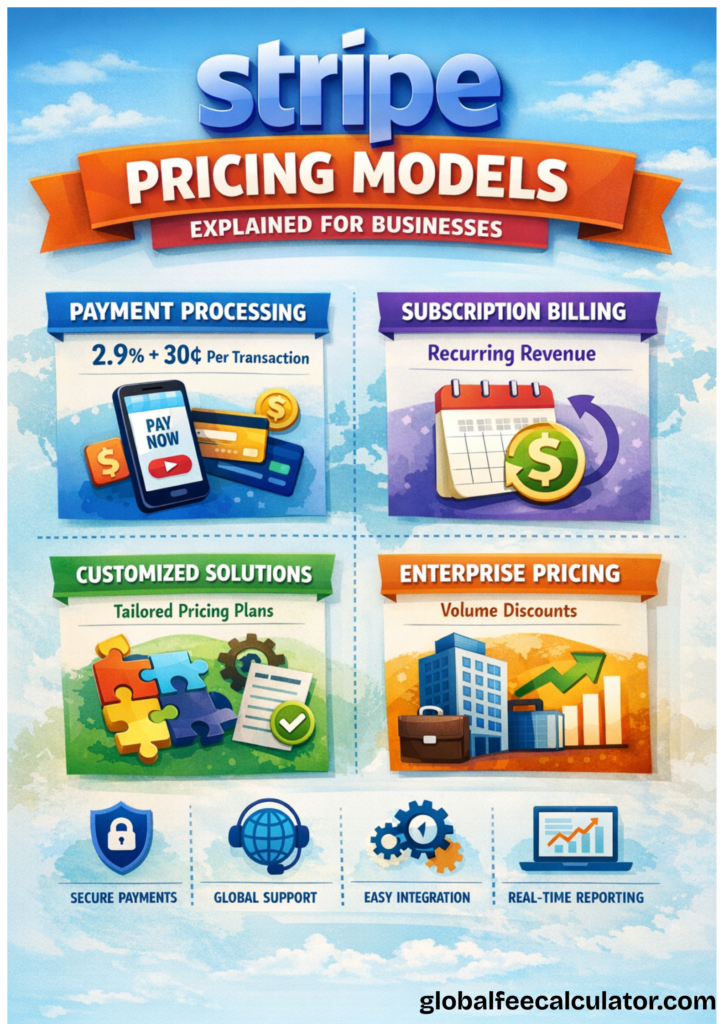
Stripe offers flexible and powerful payment infrastructure, but its pricing models are layered and context-dependent. Understanding how these models work is essential for sellers, SaaS founders, and small businesses focused on profitability.
Key takeaways:
-
Stripe uses transaction-based, usage-driven pricing
-
Fixed fees heavily impact small transactions
-
International and subscription pricing require extra planning
-
Refunds and disputes increase effective costs
-
Accurate calculation is critical before scaling
Businesses that understand Stripe pricing models don’t struggle with surprises—they price intentionally, protect margins, and grow sustainably.
Frequently Asked Questions (FAQs)
1. Does Stripe have only one pricing model?
No. Stripe applies different pricing layers based on transaction type, location, and payment method.
2. Are Stripe fees the same for subscriptions and one-time payments?
The structure is similar, but subscriptions accumulate fees over time.
3. Do international transactions cost more on Stripe?
Yes. International card and currency conversion fees usually apply.
4. Why do low-priced items have high Stripe fees?
Because the fixed fee takes a larger percentage of small transactions.
5. Are all payment methods priced the same?
No. Fees vary depending on the payment method and region.
6. Can Stripe pricing be negotiated?
Usually only for very high-volume businesses.
7. Do refunds return Stripe fees?
Fixed fees and conversion costs are usually not refunded.
8. Should global businesses use different pricing models?
Yes. International pricing often requires different margins.
9. How often should Stripe pricing be reviewed?
Regularly, especially after pricing or market changes.
10. What’s the safest way to manage Stripe pricing?
Accurate calculation, transparent pricing, and regular fee review
Recommendation:
Always verify details directly on the official company website before making any business or financial decision.