

For many online businesses, Stripe feels straightforward: a clean dashboard, simple integrations, and a familiar “2.9% + 30¢” headline fee. But beneath that simplicity are hidden Stripe fees most businesses ignore—not because they’re secret, but because they’re easy to overlook during pricing and planning.
For Etsy sellers, SaaS founders, and small online businesses, fees directly affect margins. Even small miscalculations can quietly eat into profits over time. Common mistakes include:
Pricing products based only on the base Stripe fee
Ignoring currency conversion and international card costs
Forgetting dispute, refund, or payout-related charges
This article breaks down how Stripe’s fee system really works, highlights the less obvious costs, and explains practical, legal ways to manage or reduce fees. By the end, you’ll understand how to calculate total payment costs accurately and price your products with confidence
Table of Contents
ToggleUnderstanding Stripe’s Fee System
Stripe charges are not a single flat fee. They’re a combination of transaction, regional, and operational costs that vary depending on how and where you sell.
Standard Transaction Fees
Most businesses start with Stripe’s standard pricing:
Domestic card payments: ~2.9% + a fixed fee per transaction
Fixed fee: Usually $0.30 (or local currency equivalent)
This is what most sellers remember—and often the only fee they factor into pricing.
International Card Fees
If a customer uses a card issued outside your country, Stripe applies an additional international card fee. This usually adds:
An extra percentage on top of the base rate
A higher total cost than domestic payments
For businesses selling globally, this fee can significantly impact margins, especially on low-priced items.
Currency Conversion Fees
If you charge customers in one currency and settle in another, Stripe applies a currency conversion fee. This includes:
A percentage-based conversion cost
Exchange rate spreads that fluctuate daily
Many sellers don’t notice this fee because it’s embedded in the conversion, not shown as a separate line item.
Refund Fees
When you issue a refund:
Stripe does not return the fixed transaction fee
The percentage portion may or may not be returned, depending on region and policy updates
This means frequent refunds create a hidden cost even when sales volume stays the same.
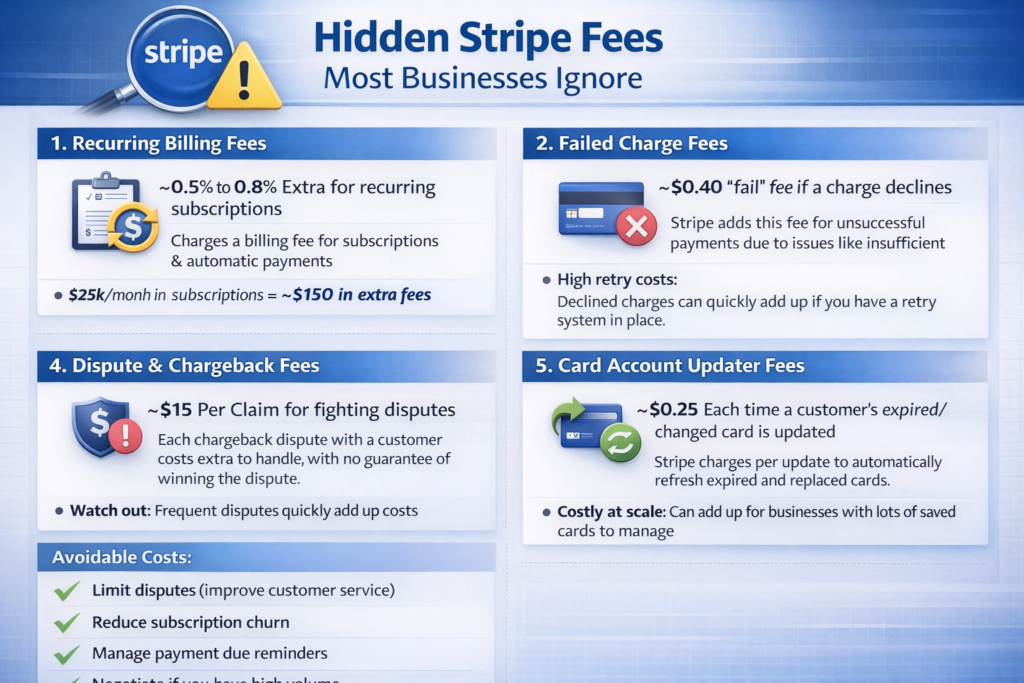
Dispute and Chargeback Fees
Chargebacks come with:
A flat dispute fee per case
Potential loss of both the product and transaction fees
Even if you win a dispute, the operational cost and time investment can be significant.
Payout and Banking Fees
Depending on your country and payout method:
Instant payouts may incur additional fees
Certain local bank transfers have processing costs
These are often ignored because they happen after the sale, not during checkout
To fully understand where these extra costs come from, it helps to first review

Less Obvious Stripe Fees Businesses Overlook
Beyond the commonly known charges, several subtle costs affect profitability.
Small Transaction Penalty Effect
On low-ticket items, the fixed fee becomes disproportionately large. For example:
-
A $5 sale with a $0.30 fixed fee equals 6% before the percentage fee is applied
This disproportionately affects Etsy sellers and digital product creators with low price points.
Mixed Payment Method Costs
Not all payment methods cost the same:
-
Cards, wallets, and local payment methods have different fee structures
-
Some “customer-friendly” methods cost businesses more
Using multiple payment options without understanding their costs leads to uneven margins.
Subscription and Recurring Billing Fees
SaaS founders often overlook:
-
Fees applied to every recurring charge
-
Costs associated with failed payment retries
Over thousands of monthly subscriptions, even small differences compound quickly
Many of these overlooked costs become more noticeable when dealing with international Stripe fees, especially for businesses serving global customers.
Practical, Legal Ways to Reduce or Manage Stripe Fees
Reducing fees doesn’t mean avoiding rules. It means designing pricing and payment flows intelligently.
Adjust Pricing With Fees in Mind
Instead of absorbing fees blindly:
-
Build average Stripe fees into your pricing
-
Account for international and conversion costs if you sell globally
This doesn’t mean raising prices aggressively—just pricing sustainably.
Optimize Transaction Size
Larger transactions reduce the impact of fixed fees. Consider:
-
Bundling products
-
Offering multi-month or annual plans instead of monthly ones
This spreads fixed fees over higher order values.
Choose Settlement Currency Carefully
If most customers pay in one currency:
-
Set that currency as your settlement currency where possible
-
Avoid unnecessary conversions
This minimizes conversion-related costs.
Reduce Refund and Dispute Rates
Operational improvements can lower indirect fees:
-
Clear product descriptions
-
Transparent refund policies
-
Better customer support before disputes escalate
Fewer disputes mean fewer lost fees and less administrative cost.
Monitor Payment Method Performance
Track which payment methods:
-
Have higher fees
-
Lead to more failed payments or disputes
Disabling or deprioritizing costly methods can improve net margins.
Because these costs vary by transaction, using a tool to calculate Stripe fees accurately helps businesses see the real impact on profit.
Common Mistakes to Avoid
Even experienced sellers make fee-related mistakes that quietly reduce profits.
Pricing Based on Gross Revenue
Looking only at sales numbers without subtracting fees creates false confidence. Profitability depends on net revenue, not total payments processed.
Ignoring International Sales Costs
Selling globally without accounting for international and conversion fees often leads to underpricing for overseas customers.
Forgetting Fixed Fees on Discounts
Discounts reduce revenue but fixed fees stay the same. Heavy discounting can turn profitable items into loss-makers.
Estimating Instead of Calculating
Guessing average fees instead of calculating real costs leads to inaccurate margins—especially when transaction sizes vary.
Identifying these costs often leads businesses to ask whether Stripe fees can be reduced through smarter payment choices and pricing strategies.
Why Accurate Fee Calculation Matters
Payment fees are predictable—but only if you calculate them correctly. When businesses guess:
-
Profits look higher than they actually are
-
Cash flow planning becomes unreliable
-
Scaling amplifies small mistakes into large losses
Accurate fee calculation allows sellers to:
-
Price products confidently
-
Forecast profits realistically
-
Make informed decisions about markets and payment methods
Using a dedicated fee calculator helps sellers see real profit before listing products, rather than discovering hidden costs after sales start coming in.
Once these hidden charges are identified, businesses can apply proven strategies to reduce Stripe fees without changing payment platforms.
Recommended Tools to Reduce These Fees
Managing Stripe fees effectively often requires better visibility rather than complex strategies. Neutral, calculation-focused tools can help businesses:
-
Estimate total transaction costs across currencies
-
Compare fees for domestic vs international sales
-
Understand the impact of refunds and chargebacks
Fee calculators designed for sellers and online businesses make it easier to model pricing scenarios and avoid underestimating costs—without changing payment providers or violating policies.
These overlooked charges often explain why businesses gradually lose profit on Stripe, even when sales volume is growing.
Final Summary
Stripe remains a powerful and reliable payment platform, but its full fee structure is more complex than many businesses realize. The hidden Stripe fees most businesses ignore—such as international charges, conversion costs, fixed-fee impacts, and refund losses—can quietly erode margins over time.
The key takeaways:
Stripe fees go beyond the advertised percentage
Small, overlooked costs add up at scale
Accurate fee calculation is essential for sustainable pricing
Legal, practical adjustments can significantly improve profitability
Smart sellers don’t guess. They calculate, plan, and price with full cost awareness protecting margins while continuing to grow.
Frequently Asked Questions (FAQs)
1. Are Stripe fees the same for all countries?
No. Fees vary based on your business location, customer location, and payment method.
2. Does Stripe charge extra for international customers?
Yes. International card payments usually include an additional fee.
3. Are Stripe fees refundable if I refund a customer?
Typically, the fixed transaction fee is not refunded.
4. Why do small transactions feel more expensive on Stripe?
Because the fixed fee takes a larger percentage of low-value transactions.
5. Do currency conversions always incur a fee?
Yes, when settlement and charge currencies differ, a conversion fee applies.
6. Are chargeback fees avoidable?
They can’t be fully avoided, but clear policies and good support reduce their likelihood.
7. Does offering more payment methods increase fees?
Sometimes. Different payment methods have different cost structures.
8. Is it risky to calculate fees manually?
Manual calculations often miss edge cases like refunds or international charges.
9. Should SaaS businesses price subscriptions differently because of Stripe fees?
Yes. Recurring billing magnifies small fee differences over time.
10. How often should businesses review their Stripe fees?
Regularly—especially when expanding internationally or changing pricing models.